Table of Contents
PREAMBLE
ARTICLE 1 – SCOPE AND INTERPRETATION
ARTICLE 2 – RECOGNITION
ARTICLE 3 – UNION RIGHTS
ARTICLE 4 – UNION DUES CHECK-OFF
ARTICLE 5 – MANAGEMENT RIGHTS
ARTICLE 6 – NO STRIKE OR LOCKOUT
ARTICLE 7 – ANTI-DISCRIMINATION AND HARASSMENT
ARTICLE 8 – RESPECTFUL WORK ENVIRONMENT
ARTICLE 9 – TITLE IX
ARTICLE 10 – ACCOMMODATIONS
ARTICLE 11 – SAFETY AND HEALTH
ARTICLE 12 – STATUS OF EMPLOYMENT, ASSIGNMENTS/DUTIES, AND JOB DESCRIPTIONS
ARTICLE 13 – JOB POSTINGS
ARTICLE 14 – SCHEDULES/HOURS OF WORK
ARTICLE 15 – WORK ARRANGEMENTS, RESOURCES, AND EXPENSES
ARTICLE 16 – MINIMUM EMPLOYMENT TERMS
ARTICLE 17 – PART-TIME EMPLOYEES
ARTICLE 18 – COMPENSATION
ARTICLE 19 – BENEFITS
ARTICLE 20 – LEAVES
ARTICLE 21 – HOLIDAYS
ARTICLE 22 – TRAINING AND PROFESSIONAL DEVELOPMENT
ARTICLE 23 – INTELLECTUAL PROPERTY
ARTICLE 24 – PERSONNEL FILES
ARTICLE 25 – CORRECTIVE ACTION AND DISCIPLINE
ARTICLE 26 – GRIEVANCES AND ARBITRATION
ARTICLE 27 – LAYOFFS
ARTICLE 28 – RELOCATION
ARTICLE 29 – LABOR-MAMNAGEMENT COMMITTEE
ARTICLE 30 – PARKING AND TRANSIT
ARTICLE 31 – TERM OF AGREEMENT
EXHIBIT A – DUES CHECK-OFF AUTHORIZATION FORM
ATTACHMENT A – CURRENT POSITION AND COMPENSATION RANGES
[Return to Top]
PREAMBLE
This Agreement is made on the first (1) day of October, 2026, by and between Washington State University, P.O. Box 641014, Pullman WA 99164, hereinafter referred to as “Employer” and the Screen Actors Guild – American Federation of Television and Radio Artists, a non- stock corporation, organized and existing under the law of the state of Delaware and having its principal offices at 5757 Wilshire Blvd., Los Angeles, CA 90036, and its Seattle Local, hereinafter referred to as “Union” or “SAG-AFTRA”. The Employer and the Union shall be collectively referred to as “the Parties.” The Employer agrees that if it transfers or assigns Northwest Public Broadcasting to any other person or entity, it will provide written notice to the Union thirty (30) calendar days in advance (or as much notice as is practicable under the circumstances) of the effective date of such transfer or assignment. The notice shall include the name and address of the prospective transferee or assignee. In accordance with applicable law, upon request by the Union, the parties shall bargain solely over the effects of the transfer or assignment on bargaining unit Employees’ terms and conditions of employment to the extent such effects are within the Employer’s authority and control prior to the effective date of the transfer or assignment.
This Agreement shall not be construed to limit the Employer’s right to manage its operations, including the structure, organization, or affiliation of Northwest Public Broadcasting, except as expressly required by applicable law.
This Agreement contains the minimum terms and conditions for the employment for covered Employees as set forth herein.
ARTICLE 1: SCOPE AND INTERPRETATION
1.1 AUTHORITY OF THE AGREEMENT
1.2 UNIVERSITY POLICY AND REGULATION
1.3 SEVERABILITY/SAVINGS CLAUSE
1.4 COLLECTIVE BARGAINING – MANDATORY SUBJECTS
1.1 AUTHORITY OF THE AGREEMENT
It is the purpose of this Agreement to provide for the wages, hours and terms and conditions of employment of the Employees covered by this Agreement.
1.2 UNIVERSITY POLICY AND REGULATION
This Agreement supersedes specific provisions of University policies with which it conflicts. Unless superseded by a specific provision of this Agreement the University’s policies, rules, regulations and procedures, as currently written or amended will apply to all Employees. The University will notify the Union of any newly created or revised policies.
1.3 SEVERABILITY/SAVINGS CLAUSE
This Agreement is subject to the law as it currently exists or is hereafter amended. If any term or provision of this Agreement is, at any time during the life of this Agreement, adjudged by a court or administrative body of competent jurisdiction to be in conflict with any law, such term or provision will become invalid and unenforceable, but all of the remaining provisions of the Agreement that are not rendered meaningless or inoperable as a consequence of the court’s or administrative body’s ruling shall remain in full force and effect. The parties shall meet as soon as practicable to negotiate in good faith with respect to any term or provision of this Agreement found to be in contravention of the law.
1.4 COLLECTIVE BARGAINING – MANDATORY SUBJECTS
- The University shall satisfy its collective bargaining obligation before changing a matter that is a mandatory subject. The University will notify the Union in writing of these changes and the Union may request discussions about and/or negotiations on the impact of these changes on Employees’ working conditions. The Union will notify the Labor Relations Officer in writing of any demands to bargain. In the event the Union does not request discussions and/or negotiations within fourteen (14) calendar days, the Employer may implement the changes without further discussions and/or negotiations. There may be emergency or mandated conditions that are outside of the Employer’s control requiring immediate implementation, in which case the Employer shall notify the Union as soon as possible.
- Unless agreed otherwise, the parties agree to begin bargaining within thirty (30) calendar days of receipt of the request to bargain. A valid request to bargain must include at least three (3) available dates and times to meet. Information requests made after the request to bargain will not delay the scheduling of discussions and/or negotiations. The parties shall agree to the location and time for the discussions and/or negotiations.
ARTICLE 2 RECOGNITION
In accordance with PERC Case No.143372-E-25, Decision 14213-B – PECB (Final Certification issued on May 28, 2026), Washington State University hereby recognizes SAG-AFTRA and its Seattle Local as exclusive bargaining representative for all Employees included in the bargaining unit. The bargaining unit is described as follows:
All full-time and regular part-time professional employees exempt from chapter 41.06 RCW employed by Washington State University – Northwest Public Broadcasting performing content creation in the following job functions: editor, producer, videographer, graphic designer, web designer, social media creator, host, journalist, reporter. Excluding confidential employees, supervisors, employees covered by chapter 41.76 RCW, employees covered by chapter 41.80 RCW, employees performing engineer, maintenance, technician and information technology functions, and employees included in any other bargaining unit.
ARTICLE 3 UNION RIGHTS
3.1 NOTICE TO THE UNION
3.2 UNION USE OF UNIVERSITY RESOURCES AND FACILITIES
3.3 UNION ORIENTATION FOR NEW BARGAINING UNIT MEMBERS
3.4 POSTING
3.5 CONTRACT TRAINING
3.6 UNION REPRESENTATIVES AND STEWARDS
3.7 RELEASE TIME
3.1 NOTICE TO UNION
- On a monthly basis, no later than the fifteenth (15th) of each month, the Employer shall provide SAG-AFTRA with a list of all active employees covered by this Agreement. The list shall include the following information, as available:
- name;
- home address;
- personal phone number;
- personal email address;
- job title;
- fill-time, part-time or other employment status; and
- salary rate
- On a monthly basis, no later than the fifteenth (15th) of each month, the Employer shall also provide a list of bargaining unit employee changes occurring since the previous report, including effective dates, for:
- newly hired employees;
- temporary or permanent reclassifications;
- promotions; and
- separations from employment
- The Employer will provide information outlined in 3.1.1 and 3.1.2 together as separate tabs in the same spreadsheet file.
3.2 UNION USE OF UNIVERSITY RESOURCES AND FACILITIES
Representatives of SAG-AFTRA shall be permitted access to Employees’ work spaces for the performance of official union business. Such visitations shall be conducted in a manner that will not be disruptive to the operations of the University
- Meeting Space and Facilities. The University’s campuses and facilities may be used by the Union for meetings upon prior request by the Union in accordance with University facilities and use policies and availability of space.
- Supplies and Equipment The University will allow the Union to post notices and information on existing, designated bulletin boards in those Departments where bargaining unit Employees work. University-purchased supplies, equipment, including but not limited to telephone, fax and email may not be used for Union business except in de minimis uses if such use does not disrupt University business.
3.3 UNION ORIENTATION FOR NEW BARGAINING UNIT MEMBERS
The Union shall be provided a thirty (30) minute period during a newly hired bargaining unit employee’s first ninety (90) days to conduct an orientation meeting to communicate with bargaining unit members and discuss/distribute materials, including Union membership application and dues deduction authorization forms. The Employer shall provide reasonable access for such orientation, subject to operational needs and scheduling requirements. Employees will remain in paid status for this meeting.
3.4 POSTING
The University will post the Agreement on the Human Resource Services Labor Relations website.
3.5 CONTRACT TRAINING
Following ratification of this Agreement, the parties may jointly develop training for management summarizing terms of the new collective bargaining agreement. The University and Union may meet semi-annually to discuss any identified training needs related to Contract administration.
3.6 UNION REPRESENTATIVES AND STEWARDS
The Union may designate bargaining unit employees who shall be recognized by the Employer as SAG-AFTRA’s employee representatives. The Union shall provide a list of names of each employee representative; should a designation of SAG-AFTRA employee representative change, the Union shall provide an updated list to the University within ten (10) days of the effective date of such change.
3.7 RELEASE TIME
- SAG-AFTRA employee representatives shall have the right to participate in representational activities concerning matters related to this Agreement including the resolution of grievances and assisting employees covered by this Agreement during an investigative interview where disciplinary action may occur. In addition to the available pool of paid release time provided for in Section 3.7.2, SAG-AFTRA employee representatives may use any combination of annual leave, personal leave day/personal holiday, accumulated compensatory time off, and/or leave without pay when participating in representational activities or any other Union activity during their work duty hours provided:
- The employee representative obtains prior approval from their supervisor, unless the conversation is of a limited, informal nature that does not interfere with work.
- The employee representative or the employee desires to meet with is not working on something that requires immediate attention. If permission cannot be immediately granted by the supervisor of the employee representative or the affected employee, the supervisor will arrange release time at the earliest possible time.
- Unless mutually agreed to by the University and the Union, not more than one (1) SAG-AFTRA employee representative shall be allowed to process a particular grievance or investigation.
- In addition to paid release time provided below, the Union is provided a pool of forty (40) hours of paid release time per fiscal year (July to June) to provide for representational duties. University-convened meetings will be considered time worked and will not be deducted from this pool. Release time is not to be used for Union Activities. Upon request by the Union, the Employer will provide information regarding the amount of release time used and the remaining balance in the Union’s release time pool. In the event the release-time pool is exhausted or otherwise insufficient, the parties will discuss whether additional release-time will be provided.
- If the University determines the amount of time a SAG-AFTRA employee representative spends performing representational activities is unduly affecting the University’s ability to accomplish the work assigned to the unit in a timely manner, the University will not continue to release the SAG-AFTRA employee representative and the Union will be notified.
- Negotiations: For the negotiations of the successor Bargaining Agreement, the University will provide a pool of up to sixty (60) hours of paid release time for allocation among the Union Table Team members. The allocation of said sixty (60) hours among the Table Team shall be determined by the Union. In the event the release-time pool is exhausted or otherwise insufficient, the parties will discuss whether additional release-time will be provided.
- No official local union representative, employee, or grievant shall be compensated by the University for any union activity, including representational activities when conducted during non-working hours.
ARTICLE 4 UNION DUES CHECK-OFF
4.1 Employees who are covered under this Agreement may choose to execute a Voluntary Checkoff Authorization Form, attached as Exhibit [A]. Such authorization forms shall be submitted by the Employee to the Union.
4.2 Upon receipt of a Voluntary Checkoff Authorization Form, the Employer shall deduct from the wages owed such Employee each payroll period, until such checkoff authorization is revoked by the Employee in accordance with the terms thereof, an amount certified by the Union as the Employee’s periodic membership dues (which may include initiation fees, assessments, and dues). The Employer shall be entitled to rely exclusively on information provided by the Union regarding such authorizations, including initiation, amounts, and revocations, and shall have no obligation to verify the validity of any authorization. The University will begin dues deductions as soon as reasonably practical, but no later than the second payroll after receipt of written notification.
4.3 If an Employee contacts the University to request that payroll deduction be ended, the University will promptly refer the Employee to the Union to process the request. An Employee may revoke their authorization for payroll deduction of payments to the Union by written notice to the Union in accordance with the terms and conditions of their authorization. The University will end dues deduction no later than the second payroll after receiving notice from the Union that an Employee has revoked authorization. The University may request a copy of an Employee’s signed card at any time.
4.4 The University will remit a payment for all deductions to the Union electronically at the end of each pay period. Accompanying the remittance will be a listing of the names, unique employee identification numbers, total wages from which Union dues/fees are calculated for the time period and the amount remitted for all Employees from whom deductions were made.
4.5 The Union agrees to indemnify, defend and hold the University harmless from any and all claims, actions, or liabilities that arise out of or by reason of actions taken by the University pursuant to this Article, including reimbursement for reasonable legal fees or expenses incurred in connection with any such claim, action or liability.
ARTICLE 5 MANAGEMENT RIGHTS
5.1 Management of the University is vested exclusively in the University. Except as otherwise provided in this Agreement, the Union agrees that the management rights of the University include the rights to:
- Establish, plan, direct and control the University’s mission, programs, objectives, activities, budget, resources, operations and priorities;
- Determine the personnel, staffing levels, methods and means, by which operations are conducted;
- Establish, revise and administer policies, procedures, reasonable rules and regulations;
- Alter, extend, or discontinue existing equipment, facilities, and location of operations;
- Establish, maintain, modify or enforce standards of performance, conduct, order and safety;
- Discipline or terminate for just cause;
- Assign work and schedule hours of work;
- Assign work locations;
- Recruit, hire, promote based on standards established by the University;
- Establish and implement policies and procedures for evaluating the performance of bargaining unit employees;
- Plan and implement any temporary or permanent reductions in force, including the identification of the specific position(s) or job classifications affected by a reduction in force.
ARTICLE 6 NO STRIKE OR LOCKOUT
6.1 During the term of this Agreement, the Union shall not authorize, instigate, encourage, ratify, or knowingly condone any strike, work stoppage, slowdown, or other concerted interruption of work by bargaining unit employees.
6.2 During the term of this Agreement, the University shall not lock out bargaining unit employees.
6.3 Nothing in this Article shall be construed to waive or limit any rights or remedies available to either party under applicable law.
ARTICLE 7 ANTI-DISCRIMINATION AND HARASSMENT
7.1 NON-DISCRIMINATION
7.2 SEXUAL HARASSMENT
7.3 RETALIATION
7.4 POLICIES
7.5 MICRO-AGGRESSIONS
7.6 RESOLUTION PROCEDURES
7.7 GRIEVANCE PROCEDURE
7.8 EDUCATION AND TRAINING RESOURCES
7.1 NON-DISCRIMINATION
- Neither the University nor the Union shall discriminate or harass any Employee on the basis of a protected class. The following, are considered protected classes for the purposes of this Article: race; sex (including pregnancy, childbirth, medical conditions related to pregnancy and childbirth, and breastfeeding and medical conditions related to breastfeeding); sexual orientation; gender identity or expression; religion; age; color; creed; national or ethnic origin (including caste or ancestry); marital status; genetic information (including family medical history); status as a protected veteran, an honorably discharged veteran, or member of the military; physical, mental, or sensory disability (including HIV status or other chronic health conditions and the use of a trained service animal); status as a victim of domestic violence, sexual assault, stalking or a hate crime; immigration or citizenship status, except as authorized by federal or state law, regulation, or government contract; Union activity; or any other category protected under applicable federal or Washington State law, including the Washington Law Against Discrimination (RCW 49.60).
University Policy and Procedure Manual (UPPM) 10.60 Policy Prohibiting Discrimination and Harassment is the University’s policy that applies to discrimination and harassment. The University’s definitions for discrimination, harassment, and sexual harassment under UPPM 10.60 is found at policies.wsu.edu/prf/index/manuals/business-policies-and-procedures-manual/bppm-10-60/.
Discrimination or retaliation based on Union activity, while prohibited under this Agreement, is not a violation of UPPM 10.60 and will not be investigated by Compliance and Civil Rights (CCR). Allegations of such discrimination or retaliation shall be addressed exclusively through the grievance and arbitration process outlined in this Agreement or with PERC. - “Gender expression” is defined as a person’s gender-related appearance or behavior, or the perception of such appearance or behavior, whether or not stereotypically associated with the person’s sex assigned at birth.
- “Gender identity” is defined as each person’s internal understanding of their gender, and associated terms that communicate that understanding, which may include man, woman, a combination of man and woman, neither man nor woman, a gender different from the person’s sex assigned at birth, transgender, or others not described here.
7.2 SEXUAL HARASSMENT
- The University shall respond promptly to reports of prohibited behavior and shall take appropriate action to prevent and correct behavior that violates the law, this Article, or University policy.
- Sexual Harassment is a form of discrimination and encompasses unwelcome conduct on the basis of sex when certain conditions are met, as defined in WSU’s UPPM 10.60, in accordance with state and federal laws and regulations. Sexual harassment also encompasses harassment of a non-sexual nature that occurs because of a person’s sex and/or gender. WSU also addresses harassment of a sexual nature based on gender identity or expression, including harassment based on a person’s nonconformity with sex stereotypes. Examples include but are not limited to those defined in UPPM 10.60 such as:
- Egregious conduct such as sexual misconduct, sexual assault, stalking, and intimate partner violence.
- Quid Pro Quo: Direct or implied threats that submission to sexual advances is a condition of employment or the basis of employment decisions, work status, promotion, work references, letters of recommendation, or other decisions affecting participation in a University program, activity, or service.
- Sexual harassment may include incidents between any members of the University community, including: administrators, faculty and other academic appointees, staff, student Employees, students, coaches, residents, interns, and non student or non-employee participants in University programs or events (e.g., vendors, contractors, visitors, and patients); in hierarchical relationships and between peers, and; between individuals of any sex or gender identity.
7.3 RETALIATION
The University prohibits retaliation, including but not limited to intimidation, threats, coercion, or discrimination. For the purpose of this Article, as outlined in UPPM 10.60, retaliation may include conduct that would discourage a reasonable person from reporting prohibited conduct or cases when the individual has made a report or complaint, testified, assisted, or participated or refused to participate in any manner in an investigation, proceeding, or hearing.
7.4 POLICIES
The University shall provide Employees with information about its non-discrimination and harassment policies.
7.5 MICRO-AGGRESSIONS
Micro-aggressions are everyday exchanges – including words and actions – that denigrate and exclude individuals based on their membership in a group or class of individuals. The Union and University shall meet, upon request, up to three (3) times per calendar year to evaluate progress on the joint goal of eliminating micro-aggressions against Employees and discuss plans to advance that goal.
7.6 RESOLUTION PROCEDURES
- A discrimination, discriminatory or sexual harassment complaint may be filed with the University Compliance and Civil Rights (CCR) office or other appropriate office and/or as a grievance in accordance with Article 26 Grievances and Arbitration of this Agreement. Employees may also file discrimination complaints with appropriate state and federal agencies. The parties agree to encourage the filing of discrimination complaints through the University CCR.
- CCR shall notify those filing complaints that union-represented Employees may have additional rights under their respective Collective Bargaining Agreement.
7.7 GRIEVANCE PROCEDURE
- Timeline: An Employee shall have 120 calendar days from an incident to submit a grievance alleging a violation of this Article.
- If a grievance is filed in accordance with Article 26 – Grievances and Arbitration that includes an alleged violation of this Article, the University shall forward the allegation(s) to the Title IX/EEO Officer for review. If the Title IX/EEO Officer determines an investigation is warranted, the Union and the University may agree in writing that the grievance, or a portion thereof, specifically related to this Article will be held in abeyance while the investigation is ongoing. If the Union and the University do not agree in writing to put the grievance in abeyance, the grievance shall continue pursuant to Article 26 – Grievances and Arbitration. While an investigation is pending the University will implement interim measures as appropriate, per Section 7.7.2 of this Article.
- As soon as practicable, after the Title IX/EEO Officer receives the grievance, they will make an initial assessment to determine whether (a) allegations describe conduct that is prohibited under UPPM 10.60, (b) such conduct is within the University’s investigative authority or jurisdiction, and (c) whether the complaint can proceed or should be dismissed pursuant to CCR’s Procedural Guidelines.
- The Title IX/EEO Officer may implement interim measures, in accordance with Section 7.7.2 below.
- In the event that a formal investigation is conducted, the investigation shall be conducted in accordance with the UPPM 10.60 and the CCR Procedural Guidelines
- When the University issues the report or otherwise concludes its review/investigation/required disciplinary hearing process/appeal, the abeyance shall automatically terminate, and the Step 1 process shall resume.
- In any event, the parties recognize that having a fair investigation and proceeding to an arbitration hearing on the merits with a completed investigation report (report of findings) is optimal. The parties may mutually agree to postpone the arbitration until the completed investigation report is available.
- Interim Measures & Remedies
- Remedies available to Employees are designed to be voluntary and restore or preserve an Employee’s access to their work, however may be implemented by the University as determined necessary. The University will consider the personal preference of an Employee when implementing interim measures and remedies. Remedies available for a grievance or complaint alleging discrimination and harassment may include, but are not limited to: change to a different workstation, schedule, work location, department, or position for which the Employee is qualified; training and education of the implicated parties; no contact remedies.
- When a grievance or complaint is filed related to harassment or discrimination, the University will offer any of the above remedies on an interim basis, as appropriate and available and will implement appropriate remedies on an ongoing basis if a complaint and/or grievance is sustained. Such measures are intended to preserve an Employee’s ability to work in an environment free from harassment and/or discrimination.
- Representation: The Employee (as a Complainant, Grievant, Respondent, or Witness) shall have the right to be represented by an advocate or advisor of their choice, including a Union representative, in the grievance, and/or complaint process.
7.8 EDUCATION AND TRAINING RESOURCES
Upon written request from SAG-AFTRA, the University and SAG-AFTRA agree to discuss effective training methodology for the prevention of sexual harassment and other forms of discrimination via the labor management committee.
ARTICLE 8 RESPECTFUL WORK ENVIRONMENT
8.1 GENERAL CONDITIONS
8.2 REPORTING COMPLAINTS
8.3 INTERIM MEASURES AND REMEDIES
8.1 GENERAL CONDITIONS
The Parties agree that all Employees shall work in an environment that fosters mutual respect and professionalism and is free from abusive conduct. All parties are responsible for contributing to such an environment in accordance with University Policies and Procedures Manual 60.52 (Maintaining a Professional Workplace).
The parties agree that abusive conduct, inappropriate behavior, and bullying in the workplace does not promote the University’s mission, employees’ wellbeing, or productivity. These behaviors may occur in, but are not limited to, situations in which one person has authority over another and situations involving peer-to-peer interactions.
Unprofessional behavior constitutes “abusive conduct” when it is sufficiently severe, persistent, or pervasive that it: interferes with, or has the potential to interfere with, an individual’s ability to participate in WSU employment, programs, or activities; adversely alters the conditions of an individual’s WSU employment, or participation status; or creates an objectively hostile or abusive employment environment.
8.2 REPORTING COMPLAINTS
Employees are strongly encouraged to report any incident of abusive conduct to an immediate manager or supervisor. If the immediate manager or supervisor is the perpetrator of the abusive conduct, the Employee should report the incident to the next level higher supervisor or directly to Human Resource Services (HRS) by completing the Abusive Behavior Incident Report form as outlined in UPPM 60.52 and/or filed as a grievance in accordance with Article 26 – Grievances and Arbitration of this Agreement.
8.3 INTERIM MEASURES AND REMEDIES
The University will implement remedies on an interim basis where appropriate. Such measures are implemented to allow the Employee to work in an environment free from abusive conduct. Remedies available for abusive conduct may include, but are not limited to staffing changes, schedule, work location, unit, department, or position for which the Employee is qualified; training and education of the implicated parties; and any other appropriate remedies.
ARTICLE 9 TITLE IX
Pursuant to Title IX of the Education Amendments Act of 1972, institutions of higher education are required to develop policies and procedures to prevent and respond to sexual violence, to train Employees and students in their rights and responsibilities under Title IX, and to properly process, investigate, and adjudicate sexual misconduct allegations. The University’s policies and procedures incorporate specific requirements of the federal law and regulations governing processing of complaints, conducting investigations and adjudications, imposing disciplinary sanctions, and resolving appeals.
ARTICLE 10 ACCOMMODATIONS
10.1 GENERAL PROVISIONS
10.2 INTERACTIVE PROCESS OF ACCOMMODATIONS
10.3 TEMPORARY WORK ADJUSTMENT
10.4 DISABILITY-RELATED ACCOMMODATIONS
10.5 PREGNANCY AND POSTNATAL ACCOMMODATIONS
10.6 DOMESTIC VIOLENCE, SEXUAL ASSAULT, HATE CRIMES, AND STALKING ACCOMMODATIONS
10.1 GENERAL PROVISIONS
- In a manner that is consistent with applicable law, the University shall provide reasonable accommodation to qualified Employees. This may include modification or adjustment to a job, work environment, policy, practice, or procedure that enables a qualified Employee to enjoy equal employment opportunity. An interactive process shall be used to determine what, if any, reasonable accommodation will be made and to monitor the continuing effectiveness of the Accommodation.
10.2 INTERACTIVE PROCESS OF ACCOMMODATIONS
- An Employee who believes they may be in need of an employment accommodation is expected to notify their supervisor, department or appropriate University office to request reasonable accommodation, as soon as they become aware of the need.
When an Employee requests reasonable accommodation, the parties will engage in the interactive process, which is an ongoing dialogue between the Employee and appropriate Employer representatives about possible options for accommodating the Employee. Both the Employer and the Employee are expected to participate in the interactive process in good faith, which includes engaging in timely communications regarding possible reasonableaccommodation. - Timeline: Within ten (10) business days of the request for reasonable accommodations, the Employer will acknowledge the request by notifying the Employee, thus initiating the interactive process. Throughout the interactive process, the Employer and Employee will engage in reasonably timely communications, taking into consideration the Employee’s unique circumstance, consisting of responses within no more than a week absent extenuating circumstances.
- During the interactive process, the Employer considers information related to the essential functions of the job, the Employee’s functional limitations and/or unique circumstances, possible accommodations, and issues related to the implementation of a reasonable accommodation. This information will be used by the Employer to determine the type of reasonable accommodation(s) that may be offered and the implementation process. If possible, the Employer will present multiple options for the Employee to consider, and the Employee will determine which accommodation(s), if any, will be implemented.
- Employees may involve a support person to assist in the interactive process, which may include a union representative.
10.3 TEMPORARY WORK ADJUSTMENT
When the interactive process is initiated, the Employer, in consultation with the appropriate University office for the associated request, shall assist in a temporary work adjustment until the interactive process is completed.
10.4 DISABILITY-RELATED ACCOMMODATIONS
- Disability definition: Presence of a sensory, mental, or physical impairment that: is medically cognizable or diagnosable; or exists as a record or history; or is perceived to exist whether or not it exists in fact.
- To qualify for a disability related reasonable accommodation:
- An impairment must be known or shown through the interactive process to exist in fact and;
- The impairment must have a substantially limiting effect
- on the Employee’s ability to perform their job,
- the Employee’s ability to apply or be considered for a job, or
- the Employee’s access to equal benefits, privileges, or terms or conditions of employment; or
- The Employee must have put the Employer on notice of the existence of an impairment, and, in accordance with the Americans with Disabilities Act and any applicable state or local legal requirements, medical documentation may be required to establish a reasonable likelihood that engaging in job functions without an accommodation would aggravate the impairment to the extent that it would create a substantially limiting effect.
- The Employer will work with Employees to determine if reasonable accommodations may be granted, based on supporting documentation of disability-related workplace accommodations with a previous employer.
- Application: If an Employee is unsure whether they qualify for formal accommodation as outlined above, they are encouraged to contact the appropriate office (Medical Leave and Accommodations) to apply for, or seek resources related to accommodations, or options that may be available to them beyond the formal process. The Employee is responsible for providing the appropriate office (Medical Leave and Accommodations) with documentation, if requested by the Employer, establishing a disability as outlined in Section 10.4.2, identifying the Employee’s functional limitations, and describing how such limitations affect the Employee’s ability to perform the functions of their job
- Options for reasonable accommodation may include, but are not limited to assistive devices; modification of existing facilities; restructuring the job to eliminate non-essential job functions; and leaves of absence.
10.5 PREGNANCY AND POSTNATAL ACCOMMODATIONS
- The Employer will allow reasonable time for an Employee to express breast milk for two years after the child’s birth, when the Employee has need to express milk. The time period may be extended by mutual agreement with their supervisor.
- In reasonable proximity to the lactating parent’s work location, Employees shall have access to spaces other than a bathroom, for the purpose of expressing and storing breast milk which will be clean and private (locked and with no view in from the outside), equipped with a table, comfortable seating, and electrical outlet. If no designated space exists in reasonable proximity to an Employee’s work location, the Employer will work with the Employee to identify a convenient location, which is not open to the general public, for the purpose of expressing and storing breast milk.
- If requested by the Employee, the Employer will allow the following as an accommodation:
- provide more frequent, longer, or flexible restroom breaks,
- modify a no food or drink policy to allow for breaks to eat or drink,
- provide seating or allow the Employee to sit more frequently if their job requires them to stand, and
- limit work related lifting demands to not over 17 pounds without the need to provide written certification from a health care provider.
- The University shall maintain a webpage listing the established lactation stations of which the University is aware, to include access instructions, and what equipment is available at each station (e.g., sink, refrigerator). These lactation stations will be available to all Employees. As of the effective date of this Agreement, the website address is: access.wsu.edu/lactation-rooms. Any Employee may submit an update to the information contained on the site at any time.
- In addition, a pregnant Employee may request other workplace accommodation(s), including, but not limited to: (1) job restructuring, part-time or modified work schedules, reassignment to a vacant position, or acquiring or modifying equipment, devices, or an Employee’s workstation, (2) providing for a temporary transfer to a less strenuous or less hazardous position, (3) scheduling flexibility for prenatal visits. The University may request the Employee seek documentation from a health care provider outlining the need for accommodation.
10.6 DOMESTIC VIOLENCE, SEXUAL ASSAULT, HATE CRIMES, AND STALKING ACCOMMODATIONS
- An Employee may request reasonable safety accommodation in response to actual, threatened, or perceived domestic violence, sexual assault, hate crime, or stalking. The University will consider the personal preference of an Employee when implementing safety accommodations. Safety accommodations are intended to preserve an Employee’s access to their work, and may include, but are not limited to: (1) transfer, reassignment, and modified schedule, (2) changed work telephone number, changed work email address, and changed workstation, (3) installed lock, implemented safety procedure, or any other adjustment to a job structure, workplace facility, or work requirement in response to actual, perceived, or threatened domestic violence, sexual assault, hate crime, or stalking.
- The University may request accommodations be supported by documentation. Appropriate documentation can include: (1) police reports or court documents, (2) an Employee’s written statement, (3) a statement from a provider, clergy, attorney, or advocate. The University may implement interim safety accommodations prior to receipt of supporting documentation.
ARTICLE 11 SAFETY AND HEALTH
11.8 SAFETY WHEN COMMUTING AND/OR PARKING
11.9 WEATHER CONCERNS
11.10 EQUIPMENT
11.11 SECURITY AND SAFETY IN THE FIELD
11.12 MENTAL HEALTH RESOURCES
11.13 ERGONOMICS
11.14 PRESS PASSES
11.15 LABOR MANAGEMENT COMMITTEE DISCUSSIONS
11.1 WSU/NWPB and SAG-AFTRA share a mutual commitment to ensuring a healthy work environment and the safety and security of Employees covered by this Agreement. The University will provide a work environment in accordance with safety practices and standards established by applicable federal and state governing agencies and University policy. The University shall make reasonable efforts to maintain safe working conditions in the workplace including equipment required to carry out assigned duties.
11.2 In partnership with appropriate University departments, the University may conduct safety and security checks of facilities, as determined appropriate by the Employer, or at the request of the Union, including on-site reviews to assure that entrances, exits (including fire safety exit procedures), hallways, offices and studios are maintained in accordance with applicable laws and regulations, including accessibility requirements
11.3 All Employees are expected to perform their work in conformity with applicable safety standards. The University will not require nor will an Employee work in an unsafe environment. Should an Employee become aware of a condition they believe is unhealthy or dangerous, they are expected to immediately report the condition to a supervisor and/or Environmental Health and Safety. Such environments will be promptly investigated.
11.4 Safety committees are established and conducted in accordance with WAC 296- 800-13020. The Union retains the right to elect Employee representatives to serve in the University-wide Safety, Health and Security committee structure, as outlined in the Safety Policies and Procedures Manual (SPPM) 1.35. Attendance at safety committee meetings will be considered time worked.
11.5 The University shall assess the hazards to which Employees are exposed and take steps to provide a safe work environment. The University shall supply and maintain all Personal Protective Equipment (PPE), equipment, tools, and materials needed to carry out job duties safely, including first aid supplies at its facilities and for Employees who work outside of the facility (e.g. reporters in the field). Employees are encouraged to raise questions or concerns over necessary PPE, equipment, tools, and materials with their advisors, supervisors, Environmental Health and Safety, or through safety processes and committees.
11.6 The University will provide notice to Employees of any known hazards in their workplace as required by applicable law. Employees may also subscribe to applicable campus/area facility event notifications and alerts to receive information regarding University facilities, including issues or projects that may impact safety and health. The University will provide as much advance notice as possible to Employees in the event that a university project may impact health and safety, such as asbestos abatement. In the event of facility conditions that may impact employee health or safety, the Employer will assess the situation and determine appropriate actions, which may include temporary modifications to work assignments, work locations, or schedules. The Employer will make reasonable efforts to maintain broadcast facilities at a comfortable working temperature consistent with operational requirements and applicable health and safety standards.
11.7 The University will provide safety information and training to Employees as appropriate based on their job duties and work environment, consistent with applicable laws and University policies. Such training may include, as determined by the Employer, topics such as general workplace safety, applicable building hazards, use of or exposure to hazardous materials, safety issues related to field work, or work in other hazardous environments, and emergency preparedness. Participation in preapproved safety trainings will be considered time worked.
11.8 SAFETY WHEN COMMUTING AND/OR PARKING
- Safety when Commuting: Employees are responsible for their commute to and from work.
- Safety when Parking: The Employer may provide information regarding available parking options and campus safety resources, including escort services where available. Decisions regarding parking access, location, and security services shall be determined by the Employer in accordance with University policies and operational considerations.
11.9 WEATHER CONCERNS
In the event of inclement weather or a public emergency that impacts operations, the Employer will assess operational needs and may, at its discretion, provide reasonable support to employees who are required to remain at or near the worksite. Any such support, including lodging, meals, or transportation, will be determined by the Employer based on the circumstances and in accordance with University policy. The Employer will maintain safe working conditions in accordance with applicable law. In situations where a weather event or emergency affects an employee’s ability to perform assigned duties, compensation and leave will be handled in accordance with applicable laws, University policies, and any applicable leave provisions of this Agreement.
11.10 EQUIPMENT
Employees assigned to field work may receive safety training, as determined by the Employer, based on the nature of their assignments and operational needs. Such training may include topics such as situational awareness and fire safety as appropriate. The Employer will determine and provide appropriate safety equipment based on assignment. For assignments involving wildfire or similar high-risk environments, the Employer will determine and provide appropriate training, equipment, and safety protocols. An Employee without appropriate fire safety equipment or training outlined above will not be assigned to cover a wildfire story in the field where such training and equipment would be necessary. The Employer will make reasonable efforts to ensure that employees assigned to higher-risk environments are appropriately prepared, consistent with applicable safety standards and operational considerations. Employee requests for additional safety equipment may be submitted for consideration and will be evaluated by the Employer based on the specific circumstances, operational needs, and available resources.
11.11 SECURITY AND SAFETY IN THE FIELD
The Employer will make reasonable efforts to provide appropriate safety measures and training for Employees working in the field. Employees are expected to promptly raise safety concerns with their supervisor. An Employee in the field may exercise their professional judgment as to matters of safety and security, including the decision to decline or discontinue an assignment when the employee has a reasonable, good-faith belief that performing the assignment would present an imminent risk to the health or safety of the employee or others. Any such concerns must be communicated to their supervisor as soon as practicable. An employee who acts in good faith under this provision shall not be subject to discipline solely for declining or discontinuing the assignment. Employees and the Employer will follow the safety regulations as set forth in the University Safety Policies And Procedures Manual and the Workplace Injury/Illness policy as set forth by Human Resource Services, including workers’ compensation benefits. Injuries or illnesses stemming from workplace exposure will be reported to appropriate governmental agencies i.e., Washington State Department of Labor and Industries, Department of Health, etc.
In the interest of Employee safety, employees may request to be assigned with another WSU Employee to cover events that may involve elevated safety risks. Such requests will be considered by the Employer based on operational needs, staffing availability, and the circumstances of the assignment.
11.12 MENTAL HEALTH RESOURCES
The Employer recognizes the importance of employee mental health and will provide access to available support resources, such as the Employee Assistance Program (EAP). Employees may utilize these resources following exposure to difficult or traumatic work assignments. Employees may use accrued sick leave in accordance with applicable law and University policy, including for qualifying mental health-related reasons. Requests for additional leave or workplace adjustments will be handled in accordance with applicable policies and operational needs. Employees are encouraged to raise concerns with their supervisor. The Employer will consider such concerns and, where appropriate, may evaluate potential adjustments.
11.13 ERGONOMICS
The Employer will provide Employees with workspaces and equipment necessary to perform their job duties while minimizing the likelihood of physical injury and discomfort, as determined appropriate by the Employer. Employees may raise ergonomic concerns to their supervisor. The Employer will review and make reasonable efforts to address ergonomic concerns based on the circumstances, operational needs, and available resources. Unresolved concerns may be appropriate for discussion through existing channels, including the Labor-Management Committee, consistent with Article 29 – Labor-Management Committee.
11.14 PRESS PASSES
Reporters and producers who are assigned to field assignments may be furnished with a press credential from NWPB, as deemed appropriate by the Employer. Upon request, the Employer will provide employment verification documentation in support of an employee’s application for an external press credential. Reimbursement for the cost of the application, if any, will be subject to prior approval and in accordance with University policy.
11.15 LABOR MANAGEMENT COMMITTEE DISCUSSIONS
In an effort to proactively approach safety related issues in the field and at the Employer’s facilities, the Parties may discuss safety and security matters consistent with Article 29 – Labor-Management Committee.
ARTICLE 12 STATUS OF EMPLOYMENT, ASSIGNMENTS/DUTIES, AND JOB DESCRIPTIONS
12.1 BARGAINING UNIT EMPLOYEES
12.2 NON-BARGAINING UNIT EMPLOYEES
12.3 JOB DESCRIPTIONS
12.1 BARGAINING UNIT EMPLOYEES
- For employment classification purposes, Employees covered by this agreement are considered Administrative Professionals
- Renewal of Temporary Appointments
- Within sixty (60) days prior to the expiration of an Employee’s current appointment, the Employee may request the status of an appointment renewal and, if applicable, discuss proposed renewal appointment terms with their supervisor. Within thirty (30) days prior to the expiration of an Employee’s current appointment, the University will provide the Employee with written notice of its decision regarding reappointment or non-reappointment. If an employee is offered a new appointment, they will have no fewer than fourteen (14) days to review, discuss, and sign their reappointment letter.
- Appointment offers/agreements will include reference to the minimum terms and conditions set forth in the collective bargaining agreement.
- The Employer retains the right to assign and modify duties. When the Employer determines there will be a significant and ongoing change to an Employee’s primary duties that is expected to substantially increase workload, the Employer will provide notice to the affected employee(s) and the Union as soon as practicable. Upon request of the Union, the parties will meet to discuss the change and its impact on affected employee(s). The Parties shall discuss the impact of the changes until mutually resolved.
- Nothing in this Agreement shall prevent an Employee or Union from addressing concerns related to workload with the Employer directly.
12.2 NON-BARGAINING UNIT EMPLOYEES
Except as limited by this section, the Employer retains the right to assign work and determine staffing. The use of non-bargaining unit employees to perform work that is normally assigned to unit employees will be as follows:
- Managers and Supervisors: Managers and supervisors may perform work that is normally assigned to bargaining unit Employees including, but not limited to, circumstances involving operational needs, training, or emergencies, provided such assignments do not result in displacement of bargaining unit employees. Managers, supervisors or other non-bargaining unit Employees may perform on-air work for fund drives, promotions, as guest appearances, or to fill in on an emergency basis.
- Temporary Employees:
- Temporary Employees are individuals employed on an as-needed basis with no set schedule, and no guarantee of ongoing employment, and are not covered by this agreement. A Temporary Employee will be considered for inclusion in the bargaining unit in accordance with applicable law, including WAC 391-35-350.
- The Employer may utilize Temporary Employees to address short-term, intermittent, or project-based needs, including but not limited to temporary vacancies, leaves of absence, or specialized productions. The use of such employees will not be for the purpose of permanently displacing bargaining unit positions.
- Temporary assignments are intended to be temporary in nature. Where a Temporary Employee is used to fill a vacant regular position on an ongoing basis, the Employer will post and recruit for the position within a reasonable timeframe, consistent with operational needs.
- Temporary Employees will be advised in writing at the time of hire of (a) their temporary status; (b) their rate of pay, and (c) the anticipated nature of the assignment.
- Temporary Employees will be paid in accordance with applicable law and Employer-established rates. They are not eligible for benefits under this Agreement unless and until they are hired into a bargaining unit position or become eligible as described in Section 12.2.2a.
- If a Temporary employee is hired into a regular bargaining unit position, the Employer may, in its discretion, provide limited credit for prior service for purposes of seniority only.
- Upon request, the Employer will provide the Union with information about the use of Temporary Employees, including dates of hire and rate of pay.
- The Employer will not utilize Temporary Employees for the purpose of permanently displacing bargaining unit employees.
- Interns
Interns are not covered by this Agreement and may be engaged through a formal internship program for educational and training purposes. Such programs may be affiliated with an academic institution, a government or privately funded internship program, or an Employer sponsored internship program for individuals. Interns may assist with work activities for learning purposes but shall not be used to replace bargaining unit Employees or to perform bargaining unit work on a regular or ongoing basis. Internships are temporary in nature and will not generally exceed six (6) months in duration. Murrow Fellows are not considered interns forthe purposes of this Agreement. - Student Workers
Student Workers are not covered by this Agreement; however, Employer will make reasonable efforts to ensure the appropriate use of Student Workers, consistent with applicable law. Student Workers are primarily engaged for educational or support purposes and are not intended to serve as a direct substitute for established bargaining unit positions in a manner that results in layoff or reduction in force. Student Workers may be utilized for seasonal, short-term, or peak workload demands, or where the work aligns with student learning opportunities. Upon reasonable request, the Employer will provide available information regarding student worker utilization during the labor-management committee meetings. SAG-AFTRA members shall not be held solely responsible for errors directly attributable to student workers, provided appropriate supervision was exercised.
The Employer retains the right to establish, maintain, support, and fund student-led organizations, programs, services, publications, productions, and similar educational activities. Such activities, when conducted primarily for student educational or experiential learning purposes, are not covered by this Agreement. - Contractors/Freelance Workers
Contractors, freelancers, consultants, and other individuals who are not employees of the Employer are not covered by this Agreement. The Employer may engage contractors or freelance workers for specialized services, unique productions, temporary projects, technical expertise, guest appearances, artistic or creative services, grant-funded work, overflow work, or operational needs where the Employer determines such use is appropriate. The use of contractors or freelance workers shall not be for the purpose of permanently displacing bargaining unit employees or avoiding the creation of regular bargaining unit positions where there is a demonstrable ongoing need for bargaining unit work. Nothing in this Section shall restrict the Employer’s right to contract for services customarily performed by independent contractors in the broadcasting, journalism, production, digital media, engineering, artistic, or related industries. Upon request, the Employer will provide the Union with information regarding the use of contractors or freelance workers, including the nature and duration of the engagement, unless prohibited by law, contractual obligation, or confidentiality requirements.
12.3 JOB DESCRIPTIONS
At least two weeks prior to the commencement of employment in a bargaining unit position, the University shall provide Employees with a job description. Employees will be given a job description as soon as practicable, but no later than the first day of the work assignment or reassignment, except in unforeseen circumstances.
Job descriptions are intended to be general summaries of duties as known at the time of issuance and are not exhaustive. The University retains the right to modify job duties, schedules, work location, and reporting relationships consistent with operational needs. The job description will set forth the essential functions of the position and may include, as applicable:
- Supervisor to whom the Employee will report
- General information regarding performance expectations
- Training/onboarding programs
- Work Location
Employees and supervisors are encouraged to communicate regarding job related duties, expectations, and time commitments associated with assigned duties.
ARTICLE 13 JOB POSTINGS
13.2 INTERNAL APPLICANTS/CADIDATES
13.7 OPEN POSITIONS
13.8 HIRING COMMITTEE
13.1 The University shall post information on a University job website regarding open recruitment for NWPB positions. Web address/es for open recruitment NWPB positions are listed on the Station’s website (https://www.nwpb.org/careers).
13.2 Internal Applicants/Candidates. Internal candidates who meet the minimum job requirements as set forth in the job posting will be granted the opportunity to interview for open positions. Any bargaining unit Employee who interviews for a posted position will be advised within thirty (30) calendar days of the interview if the Employee remains under consideration for the position.
13.3 Open recruitment positions will be posted for a minimum of two (2) weeks except in emergency situations in which the beginning of the appointment period must begin less than two (2) weeks after the position is posted.
13.4 All bargaining unit postings shall contain the following information:
- Job Classification
- Hiring unit
- A summary of the nature of required duties (job requirements, including expected hours required or appointment percentage (% FTE) if applicable, and qualifications)
- Effective dates and duration of appointment (when applicable)
- Salary range or wages
- Procedures regarding the application including the contact where inquiries and applications may be made, as applicable
- Deadlines for application
- Reference to applicable benefits options, including health insurance office contact information when applicable
- WSU’s tuition exemption program information, if applicable
- An employment non-discrimination statement
- A statement indicating that the position is covered by a collective bargaining agreement
- The collective bargaining agreement website address
13.5 The determination of job requirements and qualifications shall be made by the University. Once the University has determined the hiring criteria for a posted open recruitment position, hiring qualifications shall not be modified to be more restrictive nor job requirements to be more extensive while the position is posted.
13.6 Re-posted positions shall remain posted at a University website for no less than one (1) week.
13.7 Open Positions. The Employer will make reasonable efforts to fill open positions in a timely manner. The Employer retains sole discretion over whether and when to fill any position. If the Employer decides not to fill a posted position or is having difficulty filling a position, it will notify the Union in writing as soon as practicable.
13.8 Hiring Committee: The Employer may, at its discretion use a hiring committee or similar process for hiring any position in the SAG-AFTRA bargaining unit. The Employer retains discretion regarding the composition of any such committee, however, the Employer may include a SAG-AFTRA-represented Employee when appropriate. Any participating Employees will receive appropriate training and be subject to confidentiality requirements.
ARTICLE 14 SCHEDULES/HOURS OF WORK
14.1 REGULAR WORK SCHEDULE
14.2 SCHEDULES
14.3 FLEXIBLE WORK SCHEDULES
14.4 OVERTIME AND COMPENSATORY TIME
14.5 SHORT-TERM SCHEDULE CHANGES
14.6 LONG-TERM SCHEDULE CHANGES
14.7 TURN-AROUND TIME
14.8 NIGHT DIFFERENTIAL
14.9 ON-CALL
14.10 MINIMUM DAILY CALL
14.11 PERSONAL APPEARANCES
14.12 MANAGEMENT OF WORK SCHEDULES
14.1 REGULAR WORK SCHEDULE
The regular work schedule for full-time employees normally consists of forty (40) hours’ work within five (5) consecutive calendar days. The Employer may establish work schedules based on operational needs. The regular workday consists of eight (8) consecutive hours exclusive of a meal period, unless an alternative schedule is approved by the Employer.
14.2 SCHEDULES
Employees shall be informed of their scheduled in-time, out-time and/or expected schedule upon hire and/or re-assignment. If operational needs require a permanent change to an Employee’s schedule, the Employer will provide reasonable advance notice to the affected Employee prior to any change when practicable. Nothing in this section limits the Employer’s authority to establish, modify, or assign work schedules based on operational needs.
14.3 FLEXIBLE WORK SCHEDULES
In lieu of compensatory time, employees may choose to request a flexible work schedule. In such cases, an Employee may work a schedule during which the length of their workday may fluctuate to accommodate workflow, interview scheduling and related editorial concerns as well as personal matters that may require such an adjustment (while still maintaining the forty (40) hour workweek).
Employees who choose a flexible work schedule arrangement must submit the request in advance and such arrangements are subject to the Employer’s approval based upon operational needs and may be modified or discontinued by the Employer at any time. Flexible schedules shall not create an entitlement to overtime or premium pay, and Employees working flexible schedules shall remain eligible for overtime and premium pay as outlined by this agreement and applicable law.
14.4 OVERTIME AND COMPENSATORY TIME
All Employees covered by this agreement shall be eligible for overtime/compensatory time in accordance with applicable law and University policies, including the AP handbook and UPPM 60.59. Overtime must be approved in advance by the Employee’s supervisor.
14.5 SHORT-TERM SCHEDULE CHANGES
The Employer agrees to give at least forty-eight (48) hours’ written notice of a change in schedule.
14.6 LONG-TERM SCHEDULE CHANGES
Should the Employer need to make a significant change to an Employee’s schedule either a long-term change or a project-based change (e.g., Weekdays to Weekends; Mornings to Evenings), the Employer will give the Employee no less than fourteen (14) calendar days’ written notice and will consider employee concerns.
14.7 TURN-AROUND TIME
Full-time Employees shall be scheduled to receive twelve (12) hours rest after finishing work on any day and before reporting to work on the next day.
14.8 NIGHT DIFFERENTIAL
An Employee assigned to work a shift between the hours of 10:00 pm and 4:00 am, where no overtime compensation is received shall receive shift differential for all hours worked. The shift differential is two dollars, fifty cents ($2.50) per hour.
14.9 ON-CALL
Overtime-eligible employees may be required and formally designated to be “on- call.”.
- Employees who are “on-call” shall be available at all times by telephone and shall be capable of responding to a call in to work within a reasonable amount of time after the call is received.
- Scheduled on-call shifts that begin on a regularly scheduled workday shall be compensated at the rate of $50.00 per day (paid in addition to regular pay and overtime, if called in to work).
- On-call shifts that begin on a regularly scheduled day off shall be compensated at $75.00 per day (paid in addition to regular pay and overtime, if called in to work).
14.10 MINIMUM DAILY CALL
Minimum call shall be defined to mean the minimum number of hours that the employer must pay a fulltime employee under the following circumstances:
- The minimum call for employees who are required to work on their day off, including a holiday, shall be four (4) hours or the actual hours worked, whichever is greater, at the applicable rate, including overtime.
- The minimum daily call for all employees called back to work on the same day shall be four (4) hours, at the applicable rate, including overtime.
14.11 PERSONAL APPEARANCES
Personal appearances assigned by the station shall be considered time worked and attendance will be scheduled by the Employer after considering the employee’s availability and operational needs.
14.12 MANAGEMENT OF WORK SCHEDULES
Nothing in this Article shall limit the Employer’s right to determine staffing levels, assign work, establish or modify work schedules, require overtime consistent with applicable law and University policy, or respond to emergencies, operational needs, or special events. The Employer will make reasonable efforts to provide advance notice of schedule changes whenever practicable.
ARTICLE 15 WORK ARRANGEMENTS, REOURCES AND EXPENSES
15.1 RESOURCES
15.2 EMPLOYEE EXPENSES
15.3 WORK ARRANGEMENTS
15.1 RESOURCES
The University shall provide reasonable access to or reimbursement for facilities, services, equipment and instructional support required for the position. Examples of access that may be required include, but are not limited to:
- Office and desk space and telephone (or equivalent)
- A computer with internet access
- Computer software
- Office supplies
- Printing facilities
- and Equipment to perform duties
15.2 EMPLOYEE EXPENSES
- Employees shall receive expense reimbursement on the same basis as other University Employees and in accordance with UPPM 70.20
- Cell Phone. The Employer may provide a University-issued cell phone or a monthly allowance for work-related use of a personal cell phone in accordance with WSU UPPM Chapter 85.45. Eligibility for a University-issued device or allowance will be determined by the Employer based on job duties, operational need, and available funding, consistent with University policy. Provision of a cellular device or allowance is not an entitlement of employment and may be modified or discontinued at the Employer’s discretion.
- Travel
- Employees required to travel for work shall be reimbursed for reasonable and necessary travel and per diem in accordance with UPPM 95. Prior Supervisor approval for travel must be obtained.
- Reimbursement rates and methods shall be those provided to other University Employees, in accordance with UPPM 95.01, for any authorized travel expenses on the same basis as all other University Employees.
- Required travel time shall be compensated in accordance with applicable law, excluding normal home-to-work commuting.
- Vehicles
- Personal Vehicle Use and Mileage: Employees authorized in advance to use a privately-owned vehicle for work assignments shall be reimbursed for mileage in accordance with WSU UPPM 95.11. Employees shall not be required to transport other employees or student workers in their privately-owned vehicle without the driver’s consent.
- Employer-Provided Vehicles: The Employer will make reasonable efforts to provide access to properly functioning, insured Employer vehicles for work assignments, subject to availability and operational needs. When Employer vehicles are not available, the Employer may, at its discretion, authorize the use of a rental vehicle or a privately owned vehicle in accordance with applicable policy.
- Towing and Damage Expenses: In the event an employee’s privately owned vehicle becomes inoperable due to an accident occurring during an authorized work assignment, the Employer may reimburse reasonable towing expenses not otherwise covered by insurance, subject to prior approval when practicable.
- Deductible Reimbursement: If an employee uses a privately owned vehicle for an authorized work assignment and is involved in an accident, the Employer may reimburse the employee for all or part of the insurance deductible up to $250.00 provided that:
- The accident was not the result of the employee’s negligence or misconduct; and
- The Employee provides documentation reasonably requested by the Employer to evaluate the claim.
- Insurance Premium Increases: If the Employer requires an employee to use a privately owned vehicle for a work assignment, and the employee experiences a documented increase in personal vehicle insurance premiums directly attributable to a work-related accident the Employer may, in its discretion, reimburse a portion of such increase for a period not to exceed one (1) year, provided that:
- The employee submits documentation supporting the increase;
- The Employer may verify the reasonableness and cause of the increase; and
- Reimbursements shall cease upon separation of employment.
15.3 WORK ARRANGEMENTS
- Hybrid/Remote work Arrangements. The Employer may utilize hybrid or remote work arrangements where operationally appropriate, in accordance with UPPM 60.34. Hybrid/remote work arrangements are based on operational needs, job duties, and business considerations, and are determined solely at the Employer’s discretion. The Employer will provide the Union with reasonable notice of significant long-term changes (i.e., changes lasting longer than ninety (90) days) to hybrid or remote work arrangements. Upon request, the parties will meet to discuss the impacts of such changes. The Employer may consider hybrid/remote work opportunities for employees who are currently working fully in the WSU facilities, where operationally feasible. The Employer will provide necessary equipment for approved remote work arrangements. Employees are responsible for maintaining a suitable remote work environment including internet access, unless reimbursement is specifically authorized by the Employer (i.e. premium internet access for purposes of transferring broadcast video/audio files).
- Work Location. The Employer will provide reasonable advance notice, when practicable, to affected employees of changes to work location or significant, material changes to their assigned workspace. The Union may request to meet to discuss the impacts of such changes on the working conditions of the Employee, if any, consistent with applicable law. Such meetings shall not delay any changes to work location.
ARTICLE 16 MINIMUM EMPLOYMENT TERMS
16.1 NOTICE OF AGREEMENT
16.2 APPLICATION OF AGREEMENT
16.3 PROSPECTIVE APPLICATION
16.4 MODIFICATION OF PRESENT CONTRACT OR TERMS OF THEIR OFFER OF EMPLOYMENT
16.5 NON-WAIVER
16.6 RESERVATION OF RIGHTS
16.1 NOTICE OF AGREEMENT
The Employer will make an electronic copy of this Agreement available to employees upon hire and upon request. All offers of employment for bargaining unit positions shall be subject to the terms of this Agreement.
16.2 APPLICATION OF AGREEMENT
This Agreement establishes the minimum terms and conditions of employment for bargaining unit employees, and the Employer agrees that it will not enter into any contract with or employ any covered Employee under terms and conditions less favorable to the Employee than those set forth in this Agreement. Nothing in this Agreement shall prevent the Employer and a bargaining unit member from mutually agreeing to terms and conditions that are more favorable than those set forth herein, consistent with applicable laws and policies.
16.3 PROSEPCTIVE APPLICATION
This Agreement shall apply prospectively to bargaining unit employees upon its effective date. Nothing in this Agreement shall be construed to require retroactive modification of individual employment agreements or offers, except as expressly provided herein.
16.4 MODIFICATION OF PRESENT CONTRACT OR TERMS OF THEIR OFFER OF EMPLOYMENT
The Employer agrees for the benefit of SAG-AFTRA and all unit Employees that existing offers of employment or contracts with all such Employees are hereby modified in accordance herewith, but no terms, wages, or hours had by any such Employee which are more favorable to such Employee than the terms, wages, or hours herein specified shall be deemed so modified.
16.5 NON-WAIVER
No provision of this Agreement shall be deemed waived except by a written agreement signed by the parties. The failure of either party to enforce any provision of this Agreement shall not constitute a waiver of that provision. Any alleged violations of this Agreement shall be subject to the grievance and arbitration procedures, including applicable timelines, set forth in this Agreement.
16.6 RESERVATION OF RIGHTS
Nothing in this Article shall be construed to limit the Employer’s rights under the Management Rights Article or applicable law.
ARTICLE 17 PART-TIME EMPLOYEES
17.1 Part-time employees shall be compensated on a pro rata basis consistent with their appointment percentage and the applicable salary provisions of this Agreement.
17.2 The Employer retains the right to determine staffing levels and appointment types. The use of part-time employees shall not be utilized for the purpose of displacing or not hiring full-time employees.
17.3 The Employer will make reasonable efforts to provide advance notice of schedule changes or shift cancellations.
17.4 Part-time employees shall be eligible for leave and other benefits in accordance with applicable state law, University policy, and the provisions of this Agreement.
17.5 A part-time employee appointed to a full-time position shall receive pro-rated service credit for prior part-time employment.
A part-time employee rehired within six (6) months following a layoff may have prior service restored for seniority purposes
17.6 Part-time employees shall be scheduled for a minimum shift of four (4) hours unless the employee and supervisor mutually agree to a shorter shift.
17.7 Consistent with the minimum shift requirement outlined in 17.6, part-time employees who report to work as scheduled and are released early by the Employer shall be paid for the employee’s scheduled hours for that day. Part-time employees who are called in to work on a day on which they were not regularly scheduled (for example, breaking news) shall receive a minimum of four (4) hours of pay.
17.8 Part-time employees will receive holiday pay on a pro-rated basis.
ARTICLE 18 COMPENSATION
18.1 WAGE REOPENER
18.2 CLASSIFICATION REVIEW
18.3 SALARY INCREASES
18.4 PROMOTIONS
18.5 TEMPORARY HIGHER-LEVEL ASSIGNMENTS
18.6 LANGUAGE DIFFERENTIAL
18.7 SALARY OVERPAYMENT
18.8 CURRENT POSITION AND COMPENSATION RANGES
18.1 WAGE REOPENER
The parties agree to reopen Article 18 – Compensation for negotiations concerning compensation effective July 1, 2027. Either party may provide written notice to the other party of its intent to reopen negotiations no later than sixty (60) calendar days prior to July 1, 2027.
18.2 CLASSIFICATION REVIEW
- Existing Positions: The Employer acknowledges the need to conduct a comprehensive review of bargaining unit classifications and job descriptions, including the duties, responsibilities, qualifications, knowledge, skills and abilities (KSAs), and other objective, job-related factors associated with bargaining unit positions and work.
The Employer will complete the classification review by July 1, 2027, and will endeavor to complete the review as expeditiously as reasonably practicable. The review will utilize consistently applied, objective, and job-related criteria, including consideration of the skills, knowledge, duties, responsibilities, and other relevant factors associated with positions in the media industry. The Employer will document the classification criteria used in the review and will make the resulting classification framework available to employees upon completion of the review. The July 1, 2027, date may be extended by request and mutual agreement as reasonably necessary based on the scope or complexity of the review, the availability of necessary information, or other circumstances reasonably affecting completion of the review. The Employer will provide the Union with a request for any extension and an updated anticipated completion date.
The Employer will provide periodic status updates through the labor-management meetings outlined in Article 29. SAG-AFTRA may provide feedback regarding the review process. Such feedback will be considered by the Employer but will not constitute approval rights or joint decision-making authority regarding classifications, job descriptions, job families, or compensation.
Upon completion of the review, the Employer will communicate applicable classification determinations to affected employees and address any resulting changes in accordance with the applicable provisions of this Agreement and applicable law. Upon request, the Employer will provide an affected employee an opportunity to discuss the employee’s classification determination and, if requested by the employee, a SAG-AFTRA representative can attend. - The parties acknowledge that completion of the classification review does not predetermine or guarantee any particular classification, job family, job description, minimum salary, salary increase, or other compensation adjustment.
- New Positions: For newly established bargaining unit positions/positions not included in Attachment A at ratification, the Employer will determine the appropriate classification based on the duties, responsibilities, qualifications, knowledge, skills and abilities and other objective, job-related factors associated with the position. The Employer will provide the Union with notice of the proposed classification and minimum salary, and upon request, bargain in good faith concerning the minimum salary consistent with applicable law.
- No current employees’ salaries or hourly rates will be reduced if they exceed the minimums for their positions. Employer reserves the right to hire and pay employees above these minimums at its discretion.
18.3 SALARY INCREASES
- Effective upon mutual ratification of this Agreement by the bargaining unit and the University, Full-Time and Regular Part-Time employees covered under this Agreement shall receive the following salary increases:
- Effective the beginning of the first payroll period following mutual ratification of this Agreement by both parties, each covered Employee who was employed by the Employer on or before December 31, 2025, and remains employed, shall receive a one percent (1%) salary increase.
- Bargaining unit employees will be eligible for general salary increases in alignment with funding levels provided by the state of Washington. Employees will be eligible to receive no less than the percentage salary increase as is available to WSU exempt, non-represented groups, as defined under RCW 41.06.070.
- All wage increases, salary adjustments, or economic benefits provided under this Agreement are subject to the Employer receiving specific, appropriated funds allocated for this purpose by the State. If the State fails to fund, appropriates insufficient funds for, or subsequently reduces or withdraws funding as outlined in this Agreement, the Employer shall not be obligated to provide impacted wages, salary adjustments or the economic benefits within this Agreement.
18.4 PROMOTIONS
Employees who are promoted to a position in a higher salary grade shall receive a salary increase determined by the Employer, provided the Employee’s salary is at least the minimum of the new salary range.
18.5 TEMPORARY HIGHER-LEVEL ASSIGNMENTS
The Employer may temporarily assign an Employee to perform substantially all of the essential duties of a higher-level classification. Such assignments must be approved by management in advance and normally exceed ten (10) consecutive workdays. Employees assigned to perform substantially all of the essential duties of a higher-level classification will receive a temporary salary adjustment of five percent (5%) or the minimum of the higher salary range, whichever is greater. Temporary performance of incidental, overlapping, or shared duties does not constitute an out-of-class assignment.
18.6 LANGUAGE DIFFERENTIAL
Employees who are formally assigned by the Employer to utilize language interpretation or translation skills in a language other than English that are outside the normal duties of their position may receive a language differential of fifty dollars ($50.00) per day on days in which such duties are performed for at least two (2) cumulative hours. Employees must demonstrate proficiency as determined by the Employer. Employees whose position description identifies bilingual proficiency or interpretation/translation as an essential function are not eligible for this differential. The differential is not considered part of the employee’s base rate of pay and shall not apply when calculating overtime, or other premium payments except as required by law.
18.7 SALARY OVERPAYMENT
In the event an employee receives a salary overpayment, the process outlined in RCW 49.48.200 and RCW 49.48.210 (10) will be used to administer the recovery of wages or any associated challenge.
18.8 CURRENT POSITIONS AND COMPENSATION RANGES
Current positions and compensation ranges are located in Attachment A.
ARTICLE 19 BENEFITS
Employees covered by this Agreement will be eligible to participate in Employer-sponsored benefit plans, subject to the terms, conditions, eligibility requirements, and governing plan documents for those plans, and consistent with applicable state and federal law.
The Employer will provide notice to the Union of material changes to Employer controlled benefits as soon as practicable.
Any tuition waiver programs are subject to applicable program terms, conditions, and availability.
Disputes regarding benefit plan administration shall be governed by the applicable plan documents and are not subject to the grievance procedure, except as required by law.
ARTICLE 20 LEAVES
20.1 ANNUAL/VACATION LEAVE
20.2 SICK LEAVE
20.3 LEAVE FOR WORK-RELATED INJURY OR ILLNESS
20.4 PARENTAL LEAVE
20.5 LEAVES OF ABSENCE WITHOUT PAY
20.6 MILITARY LEAVE
20.7 EMERGENCY LEAVE
20.8 PROFESSIONAL LEAVE
20.9 SHARED LEAVE
20.10 FAMILY MEDICAL LEAVE ACT
20.11 VICTIMS OF DOMESTIC VIOLENCE, SEXUAL ASSAULT, OR STALKING LEAVE
20.12 JURY AND CIVIL DUTY
20.13 CHILDCARE EMERGENCY
20.14 REQUEST FOR LEAVE AND COVERAGE
20.15 LEAVE WITHOUT PAY FOR REASONS OF FAITH OR CONSCIENCE
20.1 ANNUAL/VACATION LEAVE
- Accrual
Full-time Administrative Professional employees earn 16.67 hours of annual leave for each month of completed service. Unused leave is cumulative to a maximum of 352 hours.
Annual leave accrues on a pro-rata basis:- For less than 100 percent appointments
- For partial months worked
Employees on less than 12-month appointments earn annual leave for each month of their scheduled work year. Leave is accrued while an employee is on paid leave. Leave is not accrued while an employee is on unpaid leave. Leave is prorated for partial months of unpaid leave.
- Use
Leave is scheduled with the approval of the unit administrator. Annual leave may not be taken before it is earned; annual leave is not earned until the first day of the following month. EXCEPTION: The annual leave hours earned during the final month of the appointment may be used in the final month.
Employees on temporary appointments must use annual leave prior to the expiration of their appointment to avoid loss of earned leave.
Administrative Professional employees are free during the time outside the service period or during annual leave to seek other employment, perform consulting work, or take advantage of educational opportunities. Employment or consulting work must be consistent with University policy and applicable laws. - Payment
Annual leave for covered Employees is paid at the time of separation from state service. Human Resource Services authorizes payment based on the total accrued leave balance. Payment is calculated with the following formula:- Hours of unused leave × monthly salary × .0063
20.2 SICK LEAVE
- Accrual
Full-time Administrative Professional employees earn eight hours of sick leave for each month of completed service.
Sick leave accrues on a pro-rata basis:- For less than 100% FTE appointments
- For partial months worked
Employees on less than 12-month appointments earn sick leave for each month of their scheduled work year. Leave is accrued while an employee is on paid leave. Leave is not accrued while an employee is on unpaid leave. Leave is prorated for partial months of unpaid leave.
- Use
Sick leave may not be taken before it is earned; sick leave is not earned until the first day of the following month. It may be used in case of illness or disability of the Administrative Professional employee or their immediate family member. Sick leave may be used for condolence or bereavement. (See Emergency Leave for additional information.) - Payment
Administrative Professional employees may participate in the sick leave Attendance Incentive Program. The policy can be found at UPPM 60.41.
In January of each year, employees may elect to receive monetary compensation for unused sick leave hours accrued in the previous year. The sick leave balance cannot be reduced to less than 480 hours.
Upon retirement or death the employee or beneficiary shall be compensated 25% of all unused sick leave. For retirement the Voluntary Employee Beneficiary Association (VEBA) Medical Expense Plan may apply.
Payment is based on two figures: (1) 25% of unused sick leave and (2) salary at the time of payment.
Payment is calculated with the following formula:- 25 percent × hours of unused sick leave × monthly salary × .005747
- WEBA Medical Expense Plan (“VEBA MEP”)
At retirement, an eligible employee may either receive benefits from the Voluntary Employee’s Benefit Association Medical Expense Plan (VEBA MEP) or receive payment for accrued sick leave. The policy can be found at hrs.wsu.edu/VEBA. - Re-employed from Former State Service
Sick Leave will be restored to former state employees who are re-employed to AP Service within three years of their separation date. Sick leave will not be restored if the employee retired and the accrued sick leave was cashed out to a VEBA Trust account.
20.3 LEAVE FOR WORK-RELATED INJURY OR ILLNESS
Employees who suffer a work-related injury or illness that is compensable under the state workers’ compensation law may select time loss compensation exclusively or a combination of time loss compensation and accrued paid leave. If the employee receives pay for accrued leave or holidays and also receives workers’ compensation for time loss, the employee is entitled to both payments without any deduction for the industrial insurance payment. For more information, call Human Resource Services at 509-335-4521 or refer to the website: https://hrs.wsu.edu/employees/medical-leave-and-accommodation/workers-compensation/.
20.4 PARENTAL LEAVE
Employees may request parental leave for up to 12 weeks for the birth and care of the employee’s newborn child or the placement of a child with the employee for adoption or foster care. This leave may be in addition to any leave for illness or temporary disability due to pregnancy and/or childbirth.
20.5 LEAVES OF ABSENCE WITHOUT PAY
The following guidelines apply to extended leave of absence without pay (LWOP). An employee granted leave must state in writing an intention to return to the service of the University for at least one year after the leave or to retire, if eligible, at the end of the leave:
- May be granted for up to 12 months by the appointing authority.
- May be extended for up to an additional 12 months upon the approval of the appointing authority and Human Resource Services.
- Requests for and actions relating to leave of absence without pay are submitted in writing in advance of the leave.
- If LWOP is for entire calendar month, annual and sick leave are not earned and cannot be taken while on leave of absence without pay.
- Annual and sick leave are pro-rated based on hours in paid status during months of partial LWOP.
- Employees on parental or disability leave without pay may use a minimum of eight hours per month of accrued leave (annual or sick) for up to four months to maintain insurance benefits. Employees are encouraged to contact Human Resource Services to determine if eight hours will be enough to cover their portion of the insurance premiums. Contact HRS at 509-335-4521.
- The granting of such leave is discretionary with the appointing authority.
20.6 MILITARY LEAVE
WSU grants employees 21 days of leave with pay for active training duty with any of the armed forces of the United States, upon receipt of military orders. Military orders are not required for those employees called to active duty. During a period of military conflict, an employee whose spouse or state registered domestic partner is a member of the military who has been called to active duty or deployed is entitled to 15 days of leave per deployment. During this period of leave, they may use their own leave accruals or request unpaid leave.
20.7 EMERGENCY LEAVE
Emergency leave applies only to cases of death of a family/household member or a comparable emergency. “Comparable emergency” is defined as severe or life-threatening illness or injury.
For purposes of emergency leave, family members include spouse, state registered domestic partner, children, parents, siblings, spouse’s parents, state registered domestic partner’s parents, spouse’s children, state registered domestic partner’s children, grandparents, grandchildren, stepparents, stepchildren, children-in-law, sibling-in-law, stepsibling, and dependents living in the employee’s home regardless of the family relationship to the employee. Household members, partners and state registered domestic partners are defined as persons who reside in the same home who have reciprocal duties to and do provide financial and/or emotional support for one another.
Such leave, with pay, may be granted to the Administrative Professional employee by the dean or other principal administrative officer in charge, provided the regular duties of the person concerned are assumed by other staff members without additional expense to the University. Up to five days’ leave shall be granted for each emergency without charge to sick leave or annual leave balances. Under exceptional circumstances, the leave may be extended to 10 days with authorization of the employee’s administrative officer and Human Resource Services.
20.8 PROFESSIONAL LEAVE
Administrative Professional employees are eligible for WSU’s Professional Leave Program. Professional leave provides an opportunity for study, research, and creative activities for the enhancement of the institution’s instructional and research programs. Each fall, the Office of the Provost announces program guidelines and application procedures.
20.9 SHARED LEAVE
The shared leave program allows state employees to donate leave to a state employee who is suffering from, or has a family/household member suffering from an extraordinary or severe illness, injury, impairment, or physical or mental condition that is likely to cause the employee to take leave without pay or terminate employment; or if an employee is called to uniformed services; or in case of volunteer service during a state of emergency; or if an employee is a victim of domestic violence, sexual assault, or stalking. To receive shared leave the employee is required to meet the following conditions:
- Have a 50% FTE or greater appointment;
- Exhaust (or will shortly exhaust) other leave balances in accordance with UPPM 60.58;
- Submit a Shared Leave application and supporting documentation.
The following criteria apply to the donation of shared leave:
- A minimum of one hour of annual or sick leave;
- All or part of a personal holiday;
- Annual leave balance may not fall below 80 hours at the time the donation is processed;
- Sick leave balance may not fall below 176 hours at the time the donation is processed.
Further information found in UPPM 60.58 or by contacting Human Resource Services at 509-335-4521.
20.10 FAMILY MEDICAL LEAVE ACT
The Family Medical Leave Act (FMLA) allows up to 12 weeks of paid or unpaid, job-protected leave to eligible employees for certain family and medical reasons for each 12-month period. An eligible employee is an employee who has worked for the state for at least 12 months and for at least 1,250 hours during the previous 12-month period. The employee may use annual leave, sick leave, leave without pay, or any combination thereof.
Family Medical Leave (FML) may be requested for the following:
- The birth of a child or placement of a child with the employee for adoption or foster care.
- To care of an employee’s spouse, child, or parent who has a serious health condition.
- A serious health condition that makes the employee unable to perform essential functions of their job.
- For any qualifying exigency arising out of the fact that a spouse, son, daughter, or parent is a military member on covered active duty or call to covered active duty status.
The combined FML for parents who are both employed by WSU cannot exceed 12 weeks for each birth, adoption, or foster care placement. Health benefits continue for the 12-week Family Medical Leave period. The employee is responsible for their share of premium payments. Employees are encouraged to contact HRS at 509-335-4521 for information on how to use their leave to cover their portion of the premiums, or to set up a payment plan to pay for their portion of the premiums.
The employee is responsible for the following:
- Completing a Request for FML in Workday;
- In general, the employee must give the employer at least 30 days’ advance notice of the need to take FML leave when the employee knows about the need for the leave in advance and it is possible and practical to do so. When the need for leave is unexpected, the employee must provide notice to the employer as soon as possible and practical;
- Providing a fitness-for-duty release prior to returning to work in the case of an employee’s serious health condition;
- Following appropriate leave notification procedures, as needed.
20.11 VICTIMS OF DOMESTIC VIOLENCE, SEXUAL ASSAULT, OR STALKING LEAVE
Employees who are victims of or have a family member who is a victim of domestic violence, sexual assault, hate crimes, or stalking may take reasonable leave from work to seek assistance, obtain medical treatment, mental health, counseling, legal assistance, confidentially secure shelter, or to participate in a safety plan. Employees may use annual leave, sick leave, leave without pay, or any combination thereof. Additional Family Medical and other leave entitlements are found in UPPM 60.56. For additional information, contact Human Resource Services at 509-335-4521.
20.12 JURY AND CIVIL DUTY
An Employee shall be eligible for leave for jury duty or as subpoenaed trial witnesses, and/or for other subpoenaed civil duty. The subpoena must be for a legal proceeding which is unrelated to the personal or financial matters of the employee. Jury duty, trial witness and/or other subpoenaed civil duty leave is leave with pay. Verification of actual jury, subpoenaed trial witness, or other subpoenaed civil duty service shall be provided by the Employee to the University upon request. Jury duty, subpoenaed trial witness, and/or other subpoenaed civil duty leave will not continue beyond the end date of the Employee’s appointment.
20.13 CHILDCARE EMERGENCY
A childcare emergency is defined as a situation causing an employee’s inability to report for or continue scheduled work because of emergency childcare requirements such as unexpected absence of regular care provider, unexpected closure of the child’s school, or unexpected need to pick up a child at school earlier than normal. Employees may use annual leave for childcare emergencies.
When an employee’s child’s school or place of care has been closed by order of a public official for any health-related reason, sick leave may be used.
20.14 REQUEST FOR LEAVE AND COVERAGE
Employees are expected to contact the supervisor to request leave as soon as the need for the leave becomes known but not less than one (1) working day in advance of the commencement of the leave, unless the leave is for an unanticipated circumstance. It is the Employer’s responsibility to make appropriate alternative arrangements to cover the assignment where applicable.
20.15 LEAVE WITHOUT PAY FOR REASONS OF FAITH OR CONSCIENCE
Leave without pay will be granted for reasons of faith and/or conscience for up to two (2) workdays per year, unless the employee’s absence would impose an undue hardship on the employer or the employee is necessary to maintain public safety.
- Leave without pay will be granted for up to two (2) workdays per calendar year for reasons of faith and/or conscience and/or an organized activity conducted under the auspices of a religious denomination, church, or religious organization. Employees must take each faith and/or conscience absence as a full day or full shift.
- Employees will only be required to identify that the request for leave is for a reason of faith or conscience.
20.16 The University will determine the method of leave/time off tracking.
ARTICLE 21 HOLIDAYS
21.1 PAID HOLIDAYS
21.2 WORK ON HOLIDAYS
21.3 PERSONAL HOLIDAY
21.4 DECEMBER HOLIDAY REDUCED OPERATIONS
21.1 PAID HOLIDAYS
WSU observes 11 paid holidays, generally 10 scheduled holidays and one personal holiday. An AP employee must be in pay status the workday prior to the holiday in order to receive pay for the holiday. All paid holidays including observed and personal holidays) during the employee’s regular work schedule are considered time worked. An employee’s workplace location determines the holiday schedule. The WSU holidays are posted at hrs.wsu.edu/resources/holiday-schedule/. Holidays occurring during an employee’s scheduled vacation are treated as holidays and not counted as vacation days.
Employees will be paid at their straight time rate for WSU-observed holidays as follows:
- Full-time employees will receive eight (8) hours of holiday pay.
- Part-time employees will receive holiday pay on a pro-rated basis.
- When a holiday falls on the employee’s regularly scheduled day off, the employee will be paid holiday pay for the holiday. At the employee’s option, the employee may choose to take an alternate date as the holiday during a regular scheduled workday after the eligible holiday is earned rather than receive the holiday pay outlined above. The employee must select an alternative date with thirty (30) days following the scheduled holiday date. The alternate holiday date will be mutually agreed to by the employee and their supervisor and will be taken on the employee’s regularly scheduled workday.
21.2 WORK ON HOLIDAYS
Any full-time bargaining unit Employee who is required to work on a recognized WSU holiday shall receive holiday pay under Section 1, and in addition, shall be compensated at one and one-half (1 1⁄2) times their hourly rate for all hours of work falling on the actual holiday (or day holiday is observed).
21.3 PERSONAL HOLIDAY
Employees are eligible for a one-day personal holiday accrued on a fiscal year basis (an employee’s workplace location may determine the personal holiday schedule) to be used:
- In a one-day block; or
- As a partial day if:
- Donated for shared leave; or
- As a partial day if used for emergency leave
- The remaining partial day may only be used for additional emergency leave or donation of shared leave.
21.4 DECEMBER HOLIDAY REDUCED OPERATIONS
December Holiday Reduced Operations occur between Christmas and New Year’s Day at WSU. During this time the University is open for essential operations while many University operations and services are unavailable or reduced with limited services. Employees covered by this Agreement may continue to be scheduled to work during reduced operations on a case-by-case basis. Reduced operations scheduling will be discussed with Employees and finalized no later than three weeks prior to the first day of reduced operations. Employees who are not scheduled to work during reduced operations may use any combination of the following options to account for hours not worked: accrued compensatory time, annual leave, personal holiday, or leave without pay.
ARTICLE 22 TRAINING AND PROFESSIONAL DEVELOPMENT
22.1 TRAINING
22.2 PROFESSIONAL DEVELOPMENT
22.1 TRAINING
- New Hire Orientation
New Employee onboarding will normally begin on or near the Employee’s first day of employment, subject to operational needs and scheduling considerations. Employees shall receive orientation and job-related training appropriate to their position, including access to essential workplace systems, policies and benefits information. - Training
- Supervisors will provide reasonable job-related instruction and may coordinate training on equipment and software used in operations.
- Employees who are promoted, reassigned, or assume a new position will be provided with reasonable training and onboarding support as determined by the Employer to perform their duties.
- Required job-related training will be compensated as work time in accordance with applicable law and Employer policy.
- Covered Employees who are scheduled by the Employer to participate in new hire orientations and / or provide training to other Employees shall be released from their assigned duties for that purpose, consistent with operational needs.
22.2 PROFESSIONAL DEVELOPMENT
- Opportunities for Professional Development and Funding
The Employer may support professional development opportunities for employees based on operational needs, job responsibilities, and available funding. Such support may include, but not limited to, internal career advancement/skills training, job-related professional development opportunities, outside vendor training, and conferences, subject to Employer approval.
The Employer will allocate funding for professional development for covered employees subject to available funding.
Employees may request funding for costs and expenses associated with job-related professional development activities. Approval is subject to operational needs, budget availability, and relevance to the employee’s position. There is no guaranteed minimum level of funding per employee.
Employees who seek funding for a professional development opportunity shall submit their request in writing to their immediate supervisor as soon as possible, and no later than thirty (30) calendar days in advance of the professional development opportunity, to allow for review and operational planning. The Employer will make reasonable efforts to notify employees in a timely manner regarding approval decisions. If a request is not approved, the Employer will provide written notice of the decision, and upon request, provide an opportunity for discussion. Approved professional development leave may be modified or rescinded due to operational needs or unforeseen circumstances. In such cases, the Employer will reimburse the Employee for any pre-approved expenses the Employee has already incurred to attend the conference or training. - Awards
With Employer approval, the Station will pay for or reimburse an employee for mandatory submission fees required by an awarding organization for job-related media or professional awards, provided such submissions are pre-approved by the Employer and consistent with operational needs and available funding. - Performance Evaluations
Employees and Supervisors are encouraged to periodically engage in informal oral performance discussions. Supervisors will provide periodic written performance feedback, including at least one written evaluation per twelve (12) month period. Written evaluations may use an independently developed or pre-established form. Supervisors and Employees will provide written acknowledgement of review of an evaluation.
ARTICLE 23 INTELLECTUAL PROPERTY
UPPM 35.55 (“University Policies on Intellectual Property, Technology Transfer, and Commercialization”) shall be incorporated into this Agreement in its entirety. Disputes over intellectual property inventorship and ownership will be resolved using the appeals process in UPPM 35.55 and will not be subject to Article 26 – Grievances and Arbitration of this Agreement. The Grievance Procedure of this Agreement will apply only in the event of discipline or termination of an Employee as a result of a violation or application of this policy.
ARTICLE 24 PERSONNEL FILES
24.1 The University will determine the location of personnel records. There will be only one (1) official personnel file that will be located in Human Resource Services. Medical information will be kept separate and confidential. Personnel, and other records containing personal information and/or information pertaining to the Employee’s performance, including those electronically generated, will be maintained, accessed, and used only in the scope of official University business.
24.2 The University will provide Employees with instructions on how to access their personnel files. Employees have the right to examine all materials contained in their personnel file and, upon request, be provided with a copy of any materials in that file. An employee may arrange to examine their own personnel records and if done during the employee’s work hours, will be subject to prior supervisory approval. The personnel file shall be made available for review within three (3) business days of the request receipt or as otherwise agreed upon. A record will be kept in the official personnel file of the names, dates, times and title of anyone who has reviewed the file, other than Human Resources and Benefits Services personnel.
24.3 An official Union representative will be granted access to the personnel records upon written authorization from the Employee to the Labor Relations Officer. The Employee and/or their official Union representative may not remove any contents.
24.4 An Employee or their official Union representative shall have the right to request removal or correction of inaccurate materials from their personnel files, insert rebuttal or refuting documentation and/or seek removal of inappropriate material from the files.
24.5 Grievance files will be kept separate from personnel files.
24.6 All materials in the personnel file of an Employee, including supervisory job performance evaluations, shall be confidential except as required to be publicly available under state and/or federal law.
24.7 Upon the Employee’s written request/release, the University will respond to employment verification inquiries. This process is described at the following website: hrs.wsu.edu/voe.
ARTICLE 25 CORRECTIVE ACTION AND DISCIPLINE
25.1 CORRECTIVE ACTION
25.2 DISCIPLINE
25.3 INVESTIGATIONS
25.4 DISCIPLINARY PROCEDURE
The University will administer corrective action or discipline in a manner that is proportionate to the nature and severity of the offense and consistent with the employee’s prior corrective action and disciplinary record. The University is not precluded from discharging an employee or imposing other significant discipline, notwithstanding the absence of prior discipline, when warranted by the nature and/or severity of the offense. When administering corrective action or discipline, the University will make reasonable efforts to protect the employee’s privacy.
25.1 CORRECTIVE ACTION
- The University supports the resolution of job-performance issues through corrective action in the form of coaching, counseling, and, where appropriate, performance improvement plans.
- Corrective actions may include verbal counsel, summary of meeting, letter of expectations, written reprimand, or counselling memoranda, and performance improvement plans. Corrective actions are not pay-affecting. Corrective actions are not considered discipline but rather an effort to resolve performance issues short of discipline. Corrective actions in and of themselves, are not grievable. Corrective actions will be labeled as such.
25.2 DISCIPLINE
- Possible disciplinary actions may include but are not limited to: suspension without pay, a performance-based job transfer, or termination during the term of an appointment. Disciplinary actions will be labeled as such.
- No Employee will be disciplined or terminated without just cause. In situations justified by the seriousness of the misconduct or unsatisfactory performance, the University may proceed to discipline or termination without prior corrective or disciplinary action, with a written explanation provided.
25.3 INVESTIGATIONS
- Union Representation: Bargaining unit Employees are entitled, at their option, to have Union representation during any investigatory interview conducted by the University that the Employee reasonably believes may result in discipline. The Employer shall notify the Employee of their right to have a Union representative attend such meeting. During any such investigatory interview, the role of the Union representative is to represent the employee, which may include asking questions, and/or offering/requesting additional information. The Union representative shall not interfere with the Employer’s right to conduct the investigation.
Representation does not apply to routine workplace interactions, such as giving instructions, assigning work, informal discussions, delivering paperwork, or staff and unit meetings. - Home Assignment/Administrative Leave: The University may place an Employee on home assignment or paid administrative leave without prior notice, in order to investigate allegations which, in the judgment of the University, require removing the Employee from the premises and/or warrant immediately relieving the Employee from all work duties. Employees on home assignment/paid administrative leave are expected to remain available during hours for which they are being compensated. Home assignment/paid administrative leave is not discipline. The Union will be notified within fourteen (14) calendar days of when an Employee is placed on home assignment/paid administrative leave. An Employee who has been placed on home assignment/administrative leave will be notified when the investigation has concluded. If the Employee receives no disciplinary action, no record of the home assignment or administrative leave will be placed in the Employee’s personnel file.
25.4 DISCIPLINARY PROCEDURE
If the University intends to impose discipline, the following procedures will apply:
- Notice of Intent to Discipline: The University will inform the Employee and the Union of the contemplated discipline in writing. The notice shall include a statement of reasons for the contemplated action, which shall include the nature of the alleged violation, the level of discipline contemplated, notice of a right to a pre-disciplinary meeting, and notice of the right to Union representation at the pre-disciplinary meeting. Upon request, the Employee shall be entitled to any materials (such as an investigative report) upon which the University has relied in determining the contemplated discipline, although confidential information and witness statements may be withheld.
- Pre-Disciplinary Meeting: The University will schedule a pre-disciplinary meeting to permit the Employee to respond to a notice of intent to discipline no earlier than seven (7) business days after the written notice. At the beginning of any pre-disciplinary meeting, the University will describe its proposed discipline and the general reasons for issuing the proposed discipline. A participating Union representative shall be entitled to speak on behalf of the Employee.
- The Employee shall be provided with a copy of a final disciplinary action as soon as practicable following its issuance. Where the Union is the designated representative, the Union shall also be provided a copy at the employee’s discretion. All copies will include the disciplinary action, the specific charges and the employee’s right to grieve the disciplinary action. The Employee has the right to place written comments on any performance-related or disciplinary documents in their personnel file which they believe to be inaccurate or incomplete. Such comments shall become a part of the file and retained in accordance with the University’s records retention policy. The inclusion of such comments in the file does not imply agreement by the Employer with the written comments, nor that the Employer has any obligation to respond to such comments.
ARTICLE 26 GRIEVANCES AND ARBITRATION
26.2 DEFINITION OF GRIEVANCES
26.3 TIME LIMITS
26.4 INFORMAL RESOLUTION
26.5 SUBMISSION OF GRIEVANCES AND RESPONSES
26.6 PROCESS
26.7 SELECTION OF AN ARBITRATOR
26.8 AUTHORITY
26.9 ARBITRATION COST
26.1 The parties recognize that disputes may occasionally arise concerning the terms and conditions of this Agreement and such disputes shall be resolved through this grievance procedure.
26.2 DEFINITION OF GRIEVANCES: A grievance is a claim by an employee or group of employees covered by this Agreement, or by the Union, that the University has committed a specific violation, misapplication or misinterpretation of the terms of this Agreement.
26.3 TIMELIMITS
- By mutual written agreement, the parties may extend any and all time limits.
- Should the grievant or Union fail to act or respond within the specified time limits, the grievance will be considered waived.
- Should the University fail to meet its time restrictions under this Article or fail to request and be granted an extension, the Union may elect to proceed to the next grievance step.
- The day after the event, act or omission shall be the first day of a timeline under this Article. Submissions will be considered timely under this Article if they are received on the last day called for under an applicable time limit. In the event that a time limit under this Article ends on a weekend or holiday, the deadline will be extended automatically to the following University business day.
26.4 INFORMAL RESOLUTION: The Union and the University encourage problem resolution between employees and management and are committed to settling disputes as soon as possible and at the lowest possible level.
26.5 SUBMISSION OF GRIEVANCES AND RESPONES
- The grievance must state the alleged violation(s), misapplication(s) or misinterpretation(s) as known at the time of filing; identify the applicable Article(s); document the date and information upon which the grievance is based; the requested remedy; and be signed by the grievant or the Union representative.
- All grievances, appeals, and requests for arbitration must be submitted to the University’s Labor Relations Officer, by hard copy or electronic mail. University responses will be submitted to the Union’s business office and the grievant (if other than the Union) by hard copy or electronic mail.
26.6 PROCESS
- A written grievance must be filed initially within thirty (30) calendar days from the occurrence of the events giving rise to the grievance, or from the time at which the Union or aggrieved individual knew or reasonably should have known of the events giving rise to the grievance.
- Step One: If not resolved informally, the employee or Union shall present a written grievance. The General Manager (or designee) shall meet with the grievant and the Union within fourteen (14) calendar days of receiving the grievance. The General Manager (or designee) shall issue a written response to the grievance within fourteen (14) calendar days of the meeting.
- Step Two: If the Union or aggrieved individual is not satisfied with the Step One response, they may appeal in writing within fourteen (14) calendar days of the Step One response or the date the Step One response was due, if no response was provided. The Dean, Vice Chancellor, or Vice President (or designee) and the Labor Relations Officer (or designee) shall meet with the Union and grievant within fourteen (14) calendar days of receiving the Step Two appeal. The Dean, Vice Chancellor, or Vice President (or designee) will issue a written response to the grievance within fourteen (14) calendar days of the meeting. The requirement of a meeting may be waived by mutual agreement.
- Step Three: If the Union or aggrieved individual is not satisfied with the Step Two response, they may appeal in writing within fourteen (14) calendar days of the Step Two response or the date the Step Two response was due, if no response was provided. The administrator designated by the University and the Labor Relations Officer (or designee) shall meet with the Union and grievant within fourteen (14) calendar days of receiving the Step Three appeal. The administrator will issue a written response to the grievance within fourteen (14) calendar days of the meeting. The requirement of a meeting may be waived by mutual agreement
- Step Four: Arbitration. In the event the parties are unable to resolve the grievance at Step Three, the Union may demand arbitration of the grievance in writing, within fourteen (14) calendar days of its receipt of the Step Three response or the date the Step Three response was due if no response was provided. The Union’s arbitration demand shall state the issue to be arbitrated, and the remedy sought.
- Mediation: Within fourteen (14) calendar days of the receipt of an arbitration demand, the University and the Union will discuss whether the parties wish to submit the grievance to mediation before the Public Employment Relations Commission (“PERC”). Upon agreement, the parties will proceed with PERC’s mediation process.
26.7 SELECTION OF AN ARBITRATOR
The parties may mutually agree upon an arbitrator. In the absence of mutual agreement to an arbitrator, the Union will request a list of seven (7) arbitrators from Washington and/or Oregon provided by the American Arbitration Association or from any other mutually agreed source. The list will be requested within fourteen (14) calendar days of Union’s arbitration demand or the date that either party provides written notice that it will no longer participate in an agreed mediation, whichever is later. Within seven (7) calendar days following the receipt of the list of eligible arbitrators, the parties’ representatives will meet or confer to select an arbitrator. The parties will each strike three (3) arbitrators from the list in an alternating order, and the remaining arbitrator shall hear the dispute. The party exercising the first strike shall be the loser of a flip of a coin.
26.8 AUTHORITY
- The arbitrator shall conduct a hearing in accordance with the rules of the American Arbitration Association. The parties agree that the arbitrator shall not have the power or jurisdiction to render a decision that adds to, subtracts from, alters, amends or modifies in any way the terms and conditions of Agreement.
- The decision of the arbitrator shall be final and binding on all parties.
26.9 ARBITRATION COST
- The expenses and fees of the arbitrator shall be shared equally by the Union and the University.
- Each party shall bear its own fees and expenses in presenting its case, including the costs of legal representation.
ARTICLE 27 LAYOFFS
27.2 NOTICE
27.3 REHIRE RIGHTS
27.4 ANNUAL LEAVE CASHOUT
27.5 BENEFITS
27.1 In the event the Employer determines a reduction in force, including reduction in hours, may be necessary, the Employer will notify the Union in writing as soon as practicable, but no less than sixty (60) calendar days prior to the effective date of implementation. Such notice shall describe the general nature and reason for the anticipated workforce reduction and shall not constitute notice of individual employee layoff selection.
Upon request, the parties will meet to discuss the effects of the workforce reduction. Effects bargaining shall be limited to the impact of the decision on employees and may include consideration of voluntary separation incentives and other mutually agreeable mitigation measures.
27.2 NOTICE
When the Employer determines a bargaining unit position will be eliminated or reduced, the Employer shall provide written notice to the affected employee and the Union no less than thirty (30) calendar days in advance of the effective date of the position elimination or reduction, unless circumstances beyond the Employer’s reasonable control prevent such notice. The Employer may provide pay in lieu of all or part of the notice period.
Employees whose positions are eliminated or reduced may be considered for vacant bargaining unit positions for which they meet the minimum qualifications. The Employer will consider affected employees for such vacancies in accordance with applicable University policies and the provisions of this Agreement. Nothing in this Section requires the Employer to create a position, displace another employee, waive qualifications, or place an employee into a position for which they are not qualified.
The notice shall include:
- The effective date of the layoff and a reference to the employee’s rights under this Article, and
- Provide applicable employment option(s).
27.3 REHIRE RIGHTS
- The Employer shall make a concerted effort to re-employ bargaining unit members on the rehire list. Employees without employment options will be placed on the rehire list(s) for a vacant position, either in the same classification from which they were laid off, or any previously held classification for which they still meet the minimum qualifications, for a period of twenty-four (24) months following the effective date of layoff. Employees identified for layoff may also request placement on a rehire list for positions of a lower FTE status in the classification from which the employee was laid off (or equivalent if prior position has been eliminated). The Employer will provide a copy of any Rehire List(s) to the Union upon request.
- Removal from List
Removal from the rehire list(s) will occur for any of the following circumstances:- If placement does not occur within twenty-four (24) months,
- If the employee refuses one (1) offer of placement for a position,
- If the employee accepts any offer of placement from any rehire list,
- Failing to make arrangements to return to work within an agreed period of time after accepting an offer of placement,
- Failing to respond within seven (7) calendar days to an offer sent to the last known address of the employee; or
- Stating in writing they no longer wish to be considered.
- Salary Setting Upon Rehire
When employees are rehired from layoff status, their annual leave accrual date will be reinstated based on prior service. Employees rehired from a rehire list into a position at the same classification and with the same FTE status as their position at the time of layoff shall be placed at a salary no less than the salary held at the time of layoff. Employees rehired into a position at the same classification and with a lower FTE status shall be placed at an equivalent salary rate to their position held at the time of layoff, commensurate to the new position’s FTE status. Employees rehired into a position in a different or lower classification shall be placed at a salary commensurate with the new position.
27.4 ANNUAL LEAVE CASHOUT
Accumulated annual leave cash-out shall be in accordance with Article 20.1.3 Leaves – Payment.
27.5 BENEFITS
Medical, vision, and dental coverage ends on the last day of the month in which an employee is paid for at least 8 hours or more in their benefit-eligible position. Medical and/or dental coverage may be continued for at least 18 months on a self-pay basis under COBRA (up to 29 months under provisions due to a Layoff/Involuntary Separation/Termination).
ARTICLE 28 RELOCATION
28.1 CHANGE OF RESIDENCE
28.2 RELOCATION ALLOWANCE
28.1 CHANGE OF RESIDENCE
The Employer retains the right to determine work location based on operational needs. In the event the Employer requires a permanent change in an employee’s work location that results in a significant increase in commuting distance, the Employer will provide sixty (60) days’ notice of the change. If operational, business, or other unforeseen circumstances make sixty (60) days’ notice impracticable, the Employer will provide as much advance notice as reasonably possible under the circumstances. Any existing Employee whose work location is permanently changed by the Employer and whose employment is ended because the Employee declines to relocate to the new work location shall be given first consideration for any vacant position for which the Employee is qualified at the Employee’s former work location or within reasonable commuting distance. The Employer shall not be required to create a position, displace another employee, or hold a position open. If no such vacancy is available at the time of separation, the Employee shall be treated as laid off and shall be eligible for layoff benefits as set forth in Article 27. This provision does not apply if an Employee’s permanent work location is moved fewer than fifty (50) miles.
28.2 RELOCATION ALLOWANCE
The Employer may provide relocation expenses for new hires or current employees who are required to move as a condition of their employment in accordance with WSU UPPM 55.62.
ARTICLE 29 LABOR MANAGEMENT COMMITTEE
29.1 A joint Labor-Management Committee (LMC) will be established to explore issues that are not the subject of an active grievance. This Committee will consist of up to four individuals designated by SAG-AFTRA and up to four individuals designated by the University. This does not include individuals attending to provide administrative support.
29.2 The parties may agree to meet on a periodic basis as needed, but no less than twice per year. If the Union requests a LMC, the University will convene an initial meeting within a reasonable timeframe.
29.3 LMC members who participate on this committee shall be released from regularly scheduled work time to attend meetings, provided operational needs permit, and shall suffer no loss of compensation for time spent in scheduled meetings.
29.4 Agendas shall be mutually agreed upon at least five (5) business days prior to the meeting. The parties may include recurring topics for discussion at LMC meetings.
29.5 Committee meetings will be used for discussion, sharing information, and problem-solving. The LMC shall not engage in collective bargaining, midterm bargaining, or contract interpretation, and no member of the Committee shall have authority to modify or waive any provision of this Agreement.
ARTICLE 30 PARKING AND TRANSIT
30.1 GENERAL CONDITIONS
30.2 PARKING
30.1 GENERAL CONDITIONS
The University and the Union agree reducing the University’s carbon footprint is a mutual goal. The University will provide access to parking and transportation programs for all Employees covered by the Agreement on the same basis these programs are provided for all other University Employees. Employees may use temporary mall service permits for official University business to access pedestrian mall areas for periods of up to fifteen (15) minutes per use. Temporary mall service permits are available at no additional cost to employees who hold a valid Employer zone permit.
30.2 PARKING
- Parking and Transit Change Notice
The University shall provide thirty (30) calendar days’ advance written notice to the Union of any University proposed change or increase in annual permits, lot designation adjustments, and hourly rates for parking and transit access on campuses/locations with bargaining unit Employees, that impact Employees covered by this Agreement. The University will provide notice as soon as practicable if thirty (30) days’ advance notice is not possible. - Event Parking and Notification
For parking access affected by events such as game days, Employee permit holders will be notified at least five (5) days prior to the event, or as soon as practicable if less than five days.
Employees holding a valid Employer zone permit affected by home football game parking restrictions may park in designated parking spaces in the lot adjacent to Jackson Hall so long as the vehicle is not blocking loading docks, dumpsters, or emergency access routes.
ARTICLE 31 TERM OF AGREEMENT
This Agreement shall be effective on October 1, 2026, and shall terminate on September 30, 2028. If this agreement expires while negotiations between the Parties are underway for a successor agreement, the terms and conditions of this Agreement will remain in effect until the effective date of a successor agreement.
Bargaining shall commence for a successor agreement no later than April 1, 2028, unless mutually agreed upon by the parties.
EXHIBIT A
DUES CHECK-OFF AUTHORIZATION FORM PDF
ATTACHMENT A
| Primary Position | Job Profile Name | Business Title (as of 9/28/26) | Compensation Grade * | Compensation Range |
| 219006 Graphic Designer Senior | Graphic Designer Senior | Graphic Designer Senior | Z1 – G05 | $4,508.70 – $6,763.06 |
| 115713 Producer-Director-Editor | Producer-Director-Editor | Producer-Director-Editor | Z1 – G04 | $4,061.90 – $6,092.84 |
| 128295 Producer-Director-Editor | Producer-Director-Editor | Producer-Director-Editor | Z1 – G04 | $4,061.90 – $6,092.84 |
| 216638 Radio Host/Producer | Radio Host/Producer | Radio Host/Producer | Z1 – G05 | $4,508.70 – $6,763.06 |
| 216637 Radio Host/Producer | Radio Host/Producer | Morning Edition Host/Producer | Z1 – G03 | $3,750.85 – $5,397.56 |
| 126435 Radio Host/Producer | Radio Host/Producer | Classical Music Radio Host/Producer | Z1 – G03 | $3,750.85 – $5,397.56 |
| 126437 Radio Host/Producer | Radio Host/Producer | Classical Music Radio Host/Producer | Z1 – G03 | $3,750.85 – $5,397.56 |
| 52781 Radio News Editor | Radio News Editor | Senior Correspondent & Special Projects Lead | Z1 – G04 | $4,061.90 – $6,092.84 |
| 111712 Radio News Editor | Radio News Editor | Sr. Correspondent, Environment & Energy | Z1 – G04 | $4,061.90 – $6,092.84 |
| 223887 Radio News Editor | Radio News Editor | Radio News Editor | Z1 – G04 | $4,061.90 – $6,092.84 |
| 217895 Radio News Editor | Radio News Editor | West Side News Reporter | Z1 – G04 | $4,061.90 – $6,092.84 |
| 217599 Radio News Editor | Radio News Editor | Inland Northwest and Health Care Reporter | Z1 – G04 | $4,061.90 – $6,092.84 |
| 219830 Web Coordinator | Web Coordinator | Senior Web Designer/Developer | Z1 – G05 | $4,508.70 – $6,763.06 |
| 228057 Music & Community Radio Producer/Host | Coordinator | Music & Community Radio Producer/Host | Z1 – G06 | $5,139.79 – $7,872.33 |
*Positions are assigned to geographic zones based upon the University assigned work location (ex. Z1 & Z2). zones are periodically assessed and locations may move zones by the University. An employee may request a review of their geographic zone based on their assigned work location.
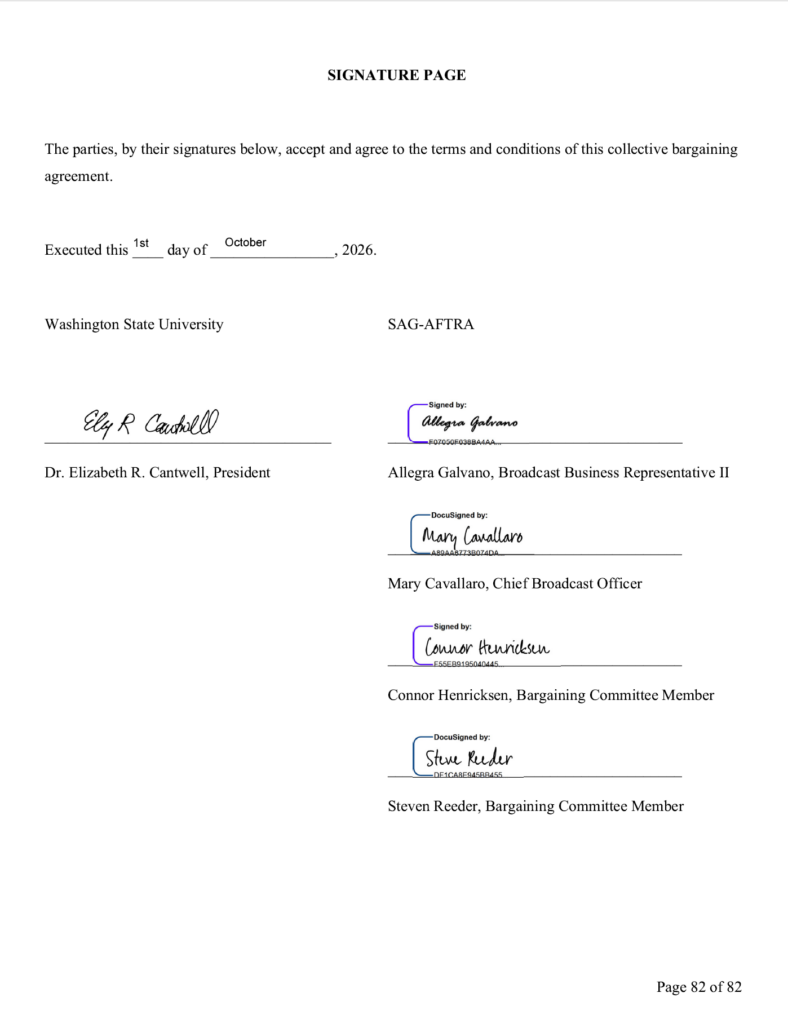
NOTICE OF NONDISCRIMINATION
In matters of admission, employment, housing or services, or in the educational programs or activities it operates, WSU does not discriminate or permit discrimination by any member of its community against any individual on the basis of sex, as required by Title IX and its implementing regulations, 34 CFR 106. Inquiries about the application of Title IX and its implementing regulations can be directed to the WSU Title IX Coordinator, the Department of Education’s Office for Civil Rights, or both. The WSU Title IX Coordinator can be reached at:
Reports and complaints about conduct that may constitute sex discrimination under Title IX can be made verbally or in writing to Compliance and Civil Rights and the university’s Title IX Coordinator at the contact information above. WSU’s prohibition on sex discrimination and relevant procedural guidelines are available here:
- WSU’s Policy Prohibiting Discrimination and Harassment
- CCR’s Procedural Guidelines
- WSU’s Standards of Conduct for Students
- Employee manuals:

Labor Relations Questions?
WSU is here to help you make informed decisions.
- For general collective bargaining and labor relations questions, email the team at hrs.labor@wsu.edu
- If you are a represented employee and you have questions about your specific bargaining agreement, contact your union representative

Quick Links
Return to the Labor Relations section page, or open the panel below for more pages.
- WSU/SAG-AFTRA 2026-2028 Collective Bargaining Agreement (CBA)
- Union Activity Guidance
- WSU/UAW-PDE 2026-2027 Collective Bargaining Agreement (CBA)
- WSU/Screen Actors Guild – American Federation of Television and Radio Artists
- Academic Student Employees Wage Increase Information
- WSU/UAW Postdocs Negotiations
- WSU/Union of American Physicians and Dentists
- WSU/UAW Postdoctoral Employees
- WSU / UAW ASE Contract Resources
- ASE Classification Descriptions
- WSU/UAW Contract Implementation FAQs
- WSU/UAW-ASE 2024 – 2026 Collective Bargaining Agreement (CBA)
- WSU/WSUPG 2025-2027 Collective Bargaining Agreement (CBA)
- WSU/IUOE 2025-2027 Collective Bargaining Agreement (CBA)
- WSU/WFSE 2025-2027 Collective Bargaining Agreement (CBA)
- WSU/United Automobile, Aerospace, and Agricultural Implement Workers of America for Academic Student Employees (ASEs)
- Representation
- WSU/WFSE Collective Bargaining Agreement
- WSU/WSU Police Guild
- WSU/International Union of Operating Engineers (IUOE)
- PEBB & Retirement Eligibility for Civil Service, Bargaining Unit, & Administrative Professional
- Flexible Scheduling Information for Managers
- Review and Evaluation Timing and Policies
- Corrective & Disciplinary Action
- CS Performance Expectations Criteria
- CS Sample Performance Expectations
- CS Performance Expectations
- Unions
- Bargaining Unit Policies
- Union Organizing
- Unexpected Visitors
- Glossary of Terms